
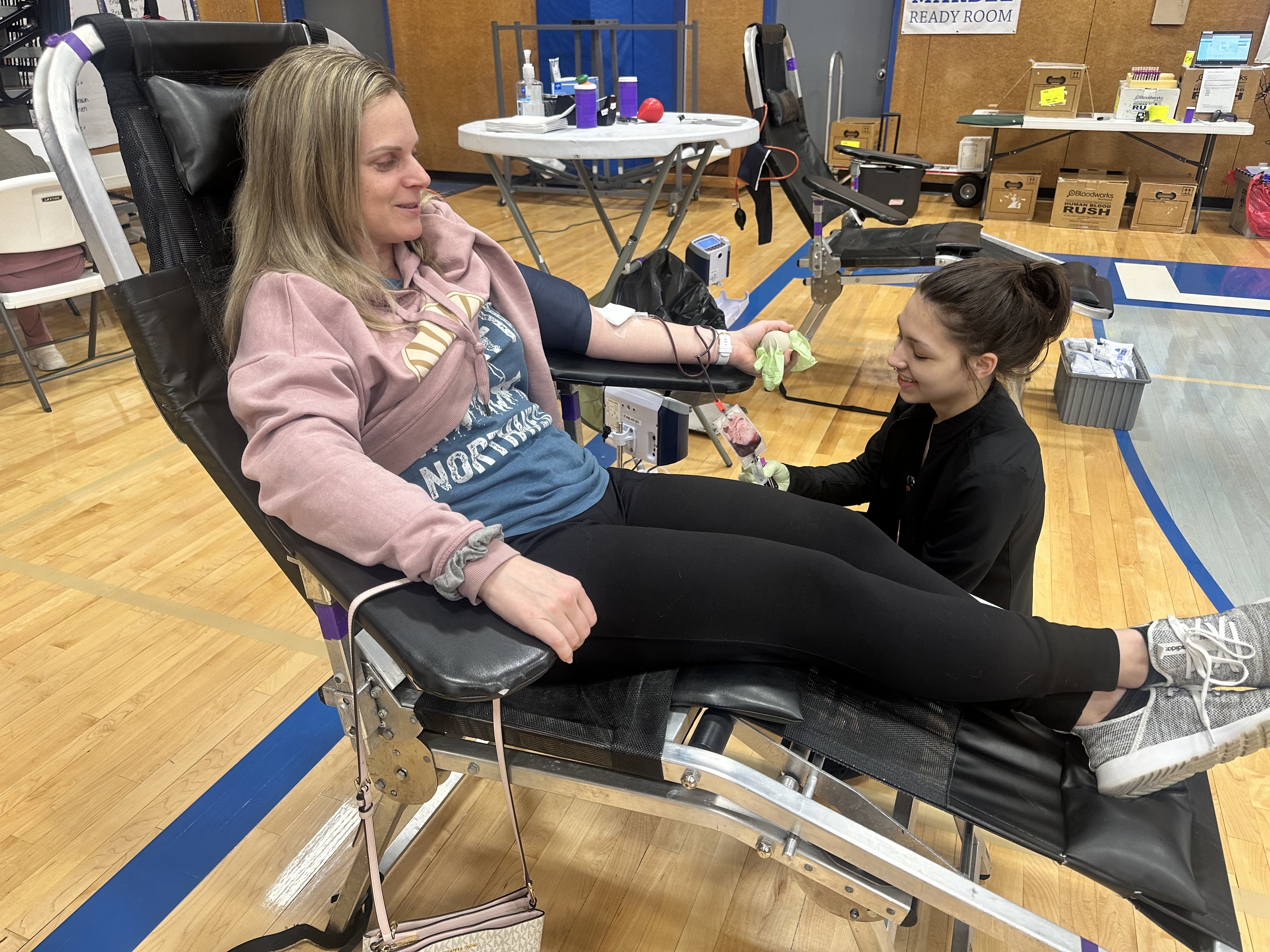
Community members rolled up their sleeves Friday, Feb. 21, at the Landy James High School Gym at La Conner High School to donate blood in a drive hosted by the Kiwanis Club of La Conner in collaboration with Bloodworks Northwest.
Forty-one slots were available during this drive and 35 volunteers registered. Twenty-eight donations were taken.
According to Hannah McNutt, community engagement liaison with Bloodworks Northwest, events like these are crucial to ensuring hospitals in the Pacific Northwest have the lifesaving blood products they need. McNutt stressed the need for attracting new donors to ensure a reliable blood supply. The blood drive on Feb. 21 drew seven first-time donors.
“We always encourage first-time donors because once they donate, they often become lifelong contributors,” she said.
Kiwanis Club member Lori Buher, who helped coordinate the drive with the La Conner Associated Student Body, emphasized the widespread impact of blood donations.

“There’s a great need, and I doubt if there’s anybody in this community who hasn’t benefited from a transfusion or had a loved one who has,” Buher said. “At different times, we’re all going to need blood, so we need to have a good supply at the ready.”
As a nurse health advocate, Dorothy Downes, a community volunteer who both donates blood and assists with local blood drives, makes herself available to answer questions from potential donors, often addressing concerns about pain, weakness, or the length of the process.
“People don’t call much, but when they do, I try to encourage them by explaining that it’s a simple, important act.”
McNutt says regular blood donations are important because blood is perishable and has a limited shelf life. Red blood cells are only viable for 42 days, and platelets last five to seven days.
Bloodworks Northwest, an independent nonprofit, supplies blood to 95% of hospitals in the Pacific Northwest, from the Canadian border to Eugene, Oregon. The organization needs at least 1,000 donors every day to meet the needs of patients in the region McNutt said.
Downes emphasized that when large-scale support efforts aren’t possible, small acts like donating blood still make a significant impact.
“More and more, when we can’t do big things, we need to do small things,” she said. “It’s an easy thing to do, it only takes an hour.”
