
By Luisa Loi
La Conner Community News
Behind much of the Dungeness crab ending up on the plates of foodies in Skagit and beyond are a fleet of skilled Swinomish tribal fishers and the experts who ensure this species can continue to be harvested in perpetuity.
As the loss of salmon habitat has resulted in “devastating declines” in salmon run sizes, shellfish are now probably the main source of revenue for Swinomish tribal fishers, according to the Swinomish Indian Tribal Community.
While exercising their treaty rights, practicing ancestral traditions and supporting their families, the Swinomish are also gathering data to assess threats to Dungeness crab populations — including the infamous European green crab — and learn more about the “Dungies,” as they are often nicknamed.
A green invader
The European green crab is one of the most invasive species in marine environments, making them the subject of numerous headlines in recent years as they are implicated in the decline of native species along both coasts of North America. Just last month, green crabs were detected on the shores of Orcas island for the first time, prompting the Washington Department of Fish and Wildlife to survey the area and deploy over 200 traps, according to KING 5.
In 2018, state and federal agencies, Tribes and other environmental organizations began noticing significant increases in green crab in Washington’s waters. While their impacts in Washington are still being assessed, the WDFW states they can cause “significant damage” locally. In 2022, former Gov. Jay Inslee declared an emergency and directed WDFW to implement measures to tackle the species’ expansion.
When Fisheries Manager, Tribal Senator and fisherman Tandy Wilbur learned that a citizen scientist had found the molt from a European green crab on Similk Beach, he was alarmed.
“It’s something we did not take lightly, and we do not even want to hear,” he said.
Following the discovery in September 2025, the Tribe set out traps on Similk Beach, Turners Bay, Kiket Lagoon and Lone Tree Lagoon to capture as many of the invaders as possible, in collaboration with Sea Grant and WDFW and with grants from WDFW, NOAA and the Bureau of Indian Affairs.
Maddie Hicks, the Tribe’s shellfish management biologist, explained European green crabs have no natural predators in this area and are highly adaptable, potentially threatening the survival of their Dungeness counterparts by competing for food, destroying habitat like eelgrass beds, and eating juvenile Dungeness.
Fortunately, only 12 green crabs were caught — three at Similk Beach, eight at Turners Bay and one at Kiket Lagoon, according to a fact sheet.
“We’re lucky that there’s not a ton that we’re finding right now,” Hicks said. “Our numbers are still really low, and we hope it stays that way.”
This work is still in the early stages, Hicks and Wilbur said, adding that the Tribe had planned to set traps in 16 sites starting in April. Once the Tribe reaches a quota of 30 green crabs trapped, it will submit them for genetic testing.
The end goal is to eradicate this species from the area completely or keep their population small enough to minimize impacts on other native species, they said.
Wilbur said he is confident his staff can handle this threat.
“I rely heavily on my staff to invade the green crab,” he laughed. “Instead of the green crab invading us.”
How you can help
The public is also welcome to give researchers a hand. For example, community members were invited to join the hunt for green crab molts at Kiket Lagoon, in the Kukutali Preserve, on July 29.
Whether you’re intentionally seeking out these unwelcome invaders or not, any beach outing can present the opportunity of adding more pieces to the puzzle and help researchers understand how widespread this issue has become.
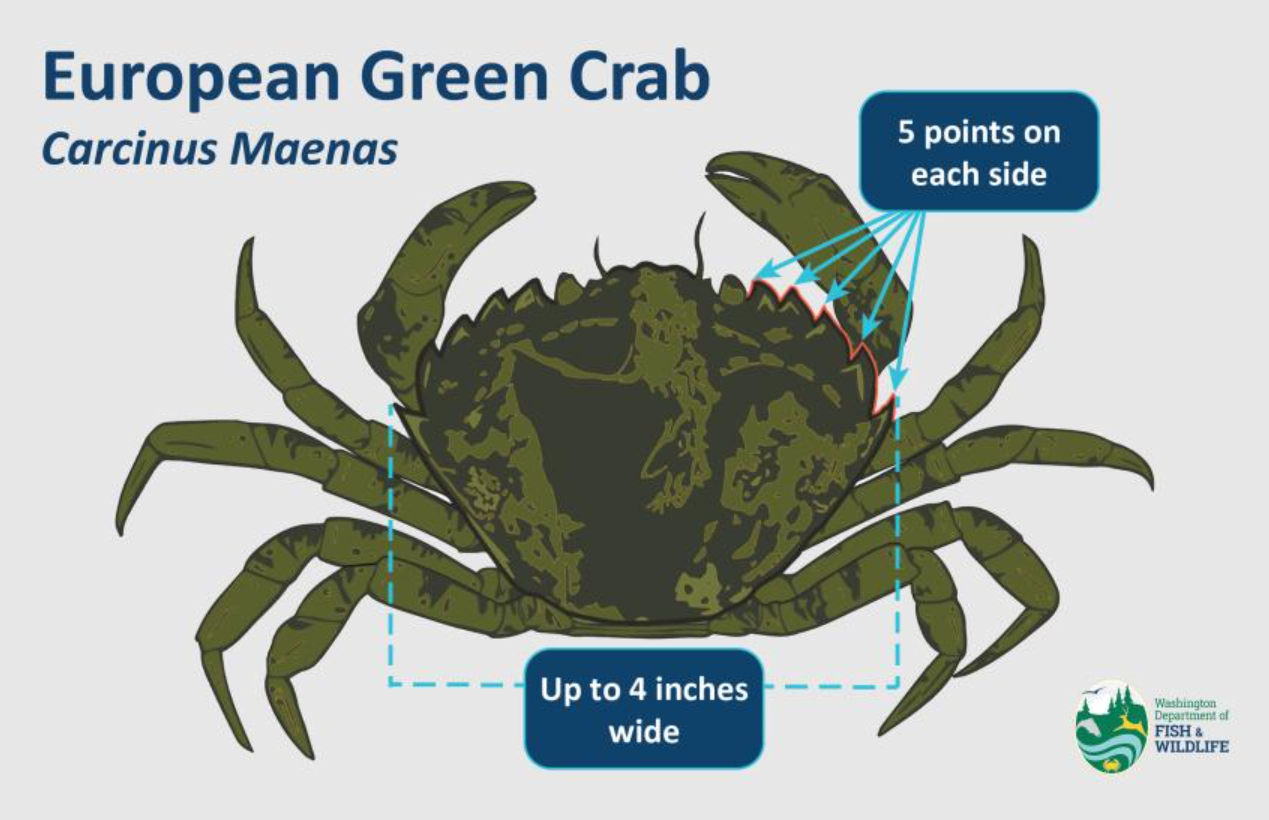
To accurately identify a European green crab, the traits to look for include aggressive behavior, five spikes or “teeth” on each side of its oval shell — which measures up to 4 inches in width — and a green, brown, yellow or reddish color, often with orange joints, according to information provided by Hicks and Wilbur.
The European green crab is not to be confused with a few look-alikes, including the purple shore crab, the hairy helmet crab, and the hairy shore crab. To quell any doubts, it’s best to check with an expert.
WDFW asks the public not to kill any crabs as they may be a misidentified native crab. It is also illegal to possess a live European green crab in Washington.
If you suspect you found a green crab on the Swinomish Reservation, call the Swinomish Fisheries Department at 360-391-3652, or send a picture and location information to Lindy Hunter (360-499-4719) or Dan Sulak (360-708-0802).
People who find a green crab out of the reservation can submit a report by visiting WDFW’s European green crab identification and reporting page at wdfw.wa.gov/species-habitats/invasive/greatest-concern/egc
Tagging
Last year, the Tribe also launched a crab tag program to study the movements of Dungeness crab across the region. The hope, Hicks said, is that someone will catch the crab and call the number on the tag to alert researchers who can then learn how far the crab traveled.
By tracking crabs, researchers seek to gain more insights about their abundance and collect data to set annual catch quotas and manage the fishing seasons, according to WDFW.
The tag includes an identification number and a phone number, and is attached to the muscle tissue in the crack where the shell splits during the molting process, which allows the tag to be retained through multiple molts.
In April 2025, staff tagged 500 male and female crabs and released them in Similk Bay, with the Tribe receiving numerous calls from fishers who caught them.
The project resumed this year, with 200 crab tagged in April in Similk Bay, 300 tagged in May in the southern end of the Saratoga Passage, and 41 tagged in northern Skagit Bay in May, Hicks reported. Since the crab pots are designed to allow females to escape, only the males were tagged this time.
One tagged crab was found in Burrows Bay, which Hicks said was surprising because they were believed to be unable to overcome the strong currents of Deception Pass and cross that area. Another crab was caught both in 2025 and 2026, growing from 149.3 mm to 179.1 mm, she said.
Swinomish is collaborating with other tribes and the state to expand this research effort.
Luisa Loi is a general assignment reporter for La Conner Community News.
