
Legacy of leadership
The late Lorraine Loomis, heralded as an advocate for salmon habitat restoration, cooperative fisheries management in Washington state, and defense of tribal treaty rights, is revered as a rock in the Swinomish Indian Tribal Community for her strong support of its cultural traditions.
It’s only fitting, then, that plaques honoring her legacy have been installed on a bench and clam garden rock at Kukutali Preserve on Swinomish Reservation.
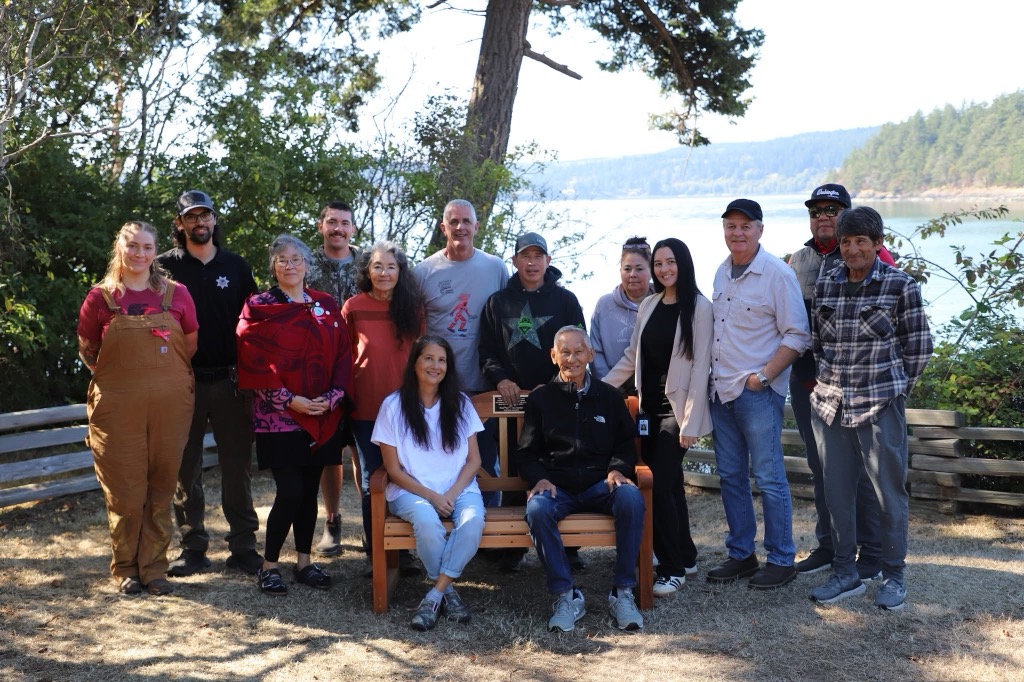
Members of Loomis’s family, the tribal community, and Swinomish Fisheries staff gathered Sept. 16 to dedicate the local clam garden — which revives an ancient shellfish aquaculture practice — in Loomis’ name.
The Swinomish shoreline project was the first modern clam garden developed in the United States. Loomis is credited with providing the leadership to make the clam garden happen.
“I’m just very proud that we’re able to dedicate this garden to Lorraine,” said Joe Williams, a former Swinomish Senator and current member of the Swinomish Fisheries shellfish team.
“She definitely had that service mentality,” said Loomis’s great-nephew, Swinomish Senator J.J. Wilbur, who was also called upon to speak. “She was a strong voice for all tribes in the Pacific Northwest.”
Wilbur noted that the bench around which family members joined together for photos at Kukutali was made by Loomis’ grandson Matt Murphy.
“He made it specially for the ceremony,” said Wilbur. “It really was a very good day.”
The daughter of longtime Swinomish leaders Laura and Tandy Wilbur, Sr., Loomis died Aug.10, 2021, at age 81. At the time of her passing, she was chairperson of the Northwest Indian Fisheries Commission (NWIFC), having succeeded the legendary Billy Frank, Jr., at the panel’s helm.
“She was a strong voice for all tribes in the Pacific Northwest.”
J.J. Wilbur
A 1958 La Conner High graduate who later attended Skagit Valley College, Loomis hailed from a family of fishers and was engaged with the industry for much of her life. In 1970, she started working at the Swinomish fish processing plant.
Five years later, in the wake of the landmark Boldt Decision that affirmed tribal treaty fishing rights, Loomis was named the Swinomish fisheries manager.
That would mark the start of her long 46-year tenure as a “salmon warrior” and widespread recognition as one of the first women to play a key role in fisheries policy and management, rising as an important figure at the tribal, state, national, and international levels.
“She was one of the greatest women warriors ever from the Pacific Northwest,” former longtime Swinomish Senate chair Brian Cladoosby said of Loomis upon her passing. “She never wavered in her fight for our treaty rights.”
Wilbur this week cited with pride the numerous fisheries-related tasks his great-aunt took on — a commitment that literally knew no boundaries.
For example, Loomis served on the Pacific Salmon Commission’s Fraser River board since its inception in 1985, extending into British Columbia her dual mission of advocacy for indigenous fishing rights and salmon conservation.
In 2020, Loomis was a recipient of the Billy Frank, Jr., Leadership Award for her decades of dedicated defense of tribal treaty rights. When Frank, a Nisqually activist and humanitarian whose image is the subject of a statue to be installed at the National Statuary Hall in Washington, D.C., died in 2014, Loomis was chosen as his successor as the NWIFC chair. In that capacity, she wrote monthly columns for NWIFC Magazine.
Her many other roles included three terms as a Swinomish Senator, from 1985-2000, and as vice-chair of the board of directors for the Skagit River System Co-Operative, the natural resources consortium of the Swinomish and Sauk-Suiattle tribes.
The Pacific Salmon Commission established a memorial scholarship in Loomis’s name in 2023. Initial funding for the award was provided by the U.S. National Marine Fisheries Service.
Wilbur said Loomis’ tireless efforts were inspired by her drive to sustain fisheries resources for generations to come.
“She was very dedicated to her work,” he said.
And now a groundbreaking sea garden project is dedicated to her memory.
Bill Reynolds is a general assignment reporter for La Conner Community News.
