
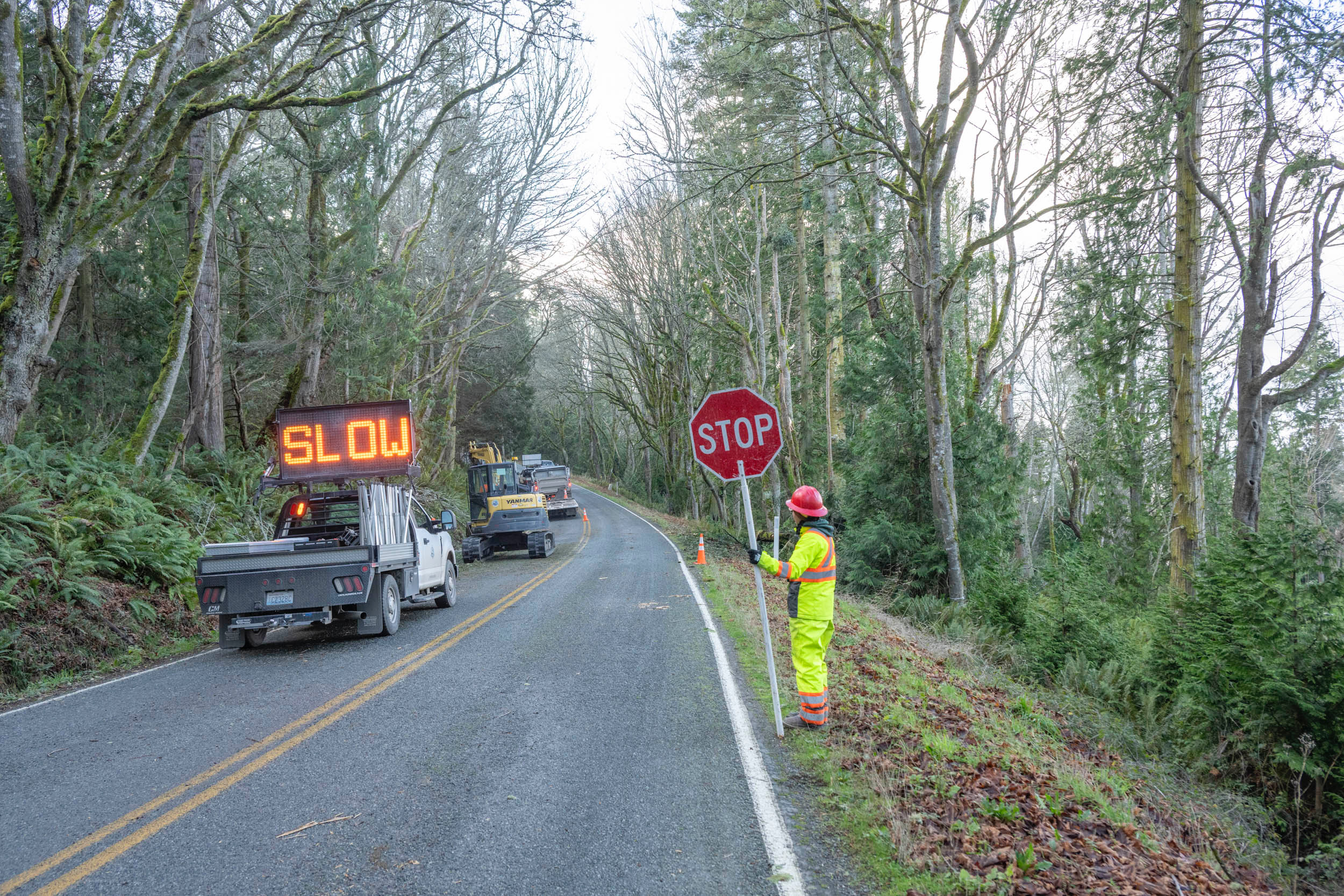
High winds battered windows and toppled trees in La Conner and the Swinomish Reservation early Wednesday, blocking Reservation Road and putting the power out for several hours.
But at midday, local authorities were grateful that the 4 a.m. high tide didn’t rise quite high enough to flood the waterfront. The town remained relatively unscathed by the weather systems tearing apart roads and flooding towns just a few miles further inland.
“La Conner is very fortunate. We are in a nice little spot and we’re protected from much of that weather,” said Fire Chief Aaron Reinstra. “We’re still monitoring it and we are still in a good situation. We are not foreseeing anything floodwise from the river; we are just monitoring king tides the way we always do.”
Indeed, dams, dikes and generations of local knowledge have kept La Conner from flooding — but so has something harder to engineer: pure, old-fashioned luck. With king tides that peaked lower than the barriers, dam reservoir space to spare, moderate temperatures and a storm track that bent just far enough north, the town avoided the catastrophic flood levels forecasters feared.

“Multiple things worked in our favor,” said Dike District 1 Commissioner and dairy farmer Jason Vander Kooy, who ticked off a list of key moments when years of planning and collaboration combined with good luck to keep La Conner dry.
“First, there was very little snow in the mountains. Second, we had a lot of storage behind the dams. Third, the temperature only got to 56-57 (degrees), and lots of times we get these atmospheric floods in the 60s, so the snow level was up there but not crazy high,” he said. “Part of the storm was more north, so we were able to take advantage of our dams.”
More than anything, he credited local control, collaboration and detailed knowledge of the area for the successful response.
“If we had to rely on the federal or state government to do our flood response, they don’t have the history or the knowledge to do that,” he said. “So it’s extremely important for local people to do the fight.”
Flood and wind risks continue
As this edition of La Conner Community News goes to print, the town remains at Evacuation Level 2 — “be ready to go” — meaning residents should have a GO bag with medications, important documents, and basic necessities packed and within reach. The storm that spared us last week has cousins, and one of them arrived Wednesday morning with pounding rain and winds estimated at 35 miles per hour.
The U.S. National Weather Service has a flood watch in effect for Skagit County through Thursday afternoon, warning “Excessive runoff may result in flooding of rivers, creeks, streams and other low-lying and flood-prone locations. Creeks and streams may rise out of their banks. Flooding may occur in poor drainage and urban areas. Storm drains and ditches may become clogged with debris. Area creeks and streams are running high and could flood with more heavy rain.”
More concerning are the king tides.
“When the wind comes out of the Strait of Juan de Fuca, it pushes the water up way high” toward the downtown boardwalk, Town Emergency Commissioner Doug Asbe said. “We were very fortunate (Wednesday morning) … the tide was only supposed to be 10 feet, but it was at 12.5 feet at 4:30 a.m. from the winds and freshwater.”
La Conner is in the middle of a three-day run of early-morning extreme high tides — Wednesday, Thursday, and Friday — each around 4 a.m. and stacking on top of already elevated river conditions.
“There’s a high potential for coastal flooding,” said U.S. National Weather Service Meteorologist Kirby Cook.
La Conner’s brand of luck
Although the town is in the 100-year flood plain, it has historically had a higher risk from coastal flooding than river flooding because of its proximity to the Swinomish Channel (close) versus the Skagit River (separated by farmland and dike districts to the north, east and south). If a high tide floods the channel, La Conner is immediately impacted. But river water can only flood La Conner after overtopping or breaking through levees and dikes and travelling miles through farmland.
That’s why communities closer to the Skagit River, like Concrete and Burlington, flooded and were evacuated and La Conner wasn’t.
La Conner also benefited from low levels in the Skagit River dams reservoirs coming into the season.
“There was a lot of storage going into this storm because it has been drier, so (the Ross and Baker dam reservoirs) were able to hold that water during the peak 24 hours,” Vander Kooy said. He estimated the Skagit River peaked around 160,000 cubic feet per second near Mount Vernon. If the dams hadn’t captured an additional 60,000 CFS, the flood would have surged beyond anything the levees could meaningfully contain.
“If we didn’t have dams, we would be like the Nooksack or the Snohomish — we’d be all under water,” he said.
But luck also looked like timing: low snowpack, moderate temperatures and a storm path that drifted north, giving the dams a chance to do what they were designed to do.
The dikes performed
Luck alone didn’t save La Conner these last few weeks. The local dike districts have been preparing for this moment for more than 30 years.
When the Fir Island dikes failed in 1990, Vander Kooy was a 15-year-old kid hauling sandbags through freezing rain. He recalled volunteers using 30,000-40,000 sandbags that year on top of the dikes, and more to create ring dikes, tiny circular barriers built around trouble spots to equalize pressure.
This time, with more water than the 1990 flood, Dike District 1 needed just a few hundred sandbags and only had to build two ring dikes to contain seeping.
“We are in much better shape today than back in 1990,” he said. “It’s night and day.”
The difference?
Seepage berms, wider levee crowns, better access roads and a unified network of dike districts working together rather than in silos.
On the north end of Dike District 1, at Edgewater Park in Mount Vernon, the district preemptively built a massive berm where the dike is lower. It turned out they didn’t need it — the river crested at 38 feet instead of the forecasted 40-plus — but Vander Kooy said waiting wasn’t an option.
“It takes 16 hours to put that (berm) in place,” he said. “You can’t wait and say ‘shoot, we gotta get going.’”
Alan Mesman, a commissioner for Drainage and Irrigation Improvement District 22, agreed. His district covers the area between the north and south forks of the Skagit River, just south and east of La Conner.
“Being able to heavily patrol dikes and throw a few sandbags down when there’s just a few tiny leaks is really helpful versus when you can’t get to these places and you have a blowout somewhere,” he said.
Freelancer Anne Basye contributed to this report.
