
Arts Alive! has long been the fall art celebration in La Conner, having started in the 1980s, featuring known regional artists and giving local artists an opportunity to showcase their work. The event was shifted from its traditional November timeframe to October a couple of years ago and it is upon us Oct. 2-5. Organized by the La Conner Arts Foundation, the event is not just a good time, but also a fundraiser to support the arts as the foundation gives scholarships to up and coming young artists.
This year, La Conner Community News reached out to each of the 11 featured invitational artists and asked them if they had a favorite work they are presenting in the show. Their responses are as varied as their artwork and, we hope, serve as an invitation to meet the artists and learn more.
Christopher Moench (Bellingham): “I can say that my favorite piece in the show is the one on the Arts Alive! poster, which is also on my website in the current inventory. I tried to capture the whole complex web of life and human activity related to the Salish Sea. And to convey the idea that all of us are collectively responsible for the well being of the land and sea where we make our home. The idea that viewers of the prayer wheel can put their own written thoughts or other mementos inside is a metaphor for how we collectively construct the shape of our community, every act matters.”


Kathleen Kemly (Seattle): “Beaver Pond I”
“I was hiking to a creek along a familiar trail that I hadn’t visited in a while. To my surprise, instead of the rocky creek I remembered, I found a watery expanse, its surface reflecting the trees and sky above. The result of hardworking beavers who both create and destroy habitat, playing an integral role in the cycles of regeneration and growth within the forest.
“In my painting, ‘Beaver Pond I,’ I want to pay tribute to the regeneration that the beaver pond sets in motion. Muddy earth and dead trees are bisected by life-giving water, leading the viewer upward toward the sky, while the light above is reflected back in the pond. Earth, water, air, and fire — the four elements that make up the Web of Life — are all present in this landscape.
As a painter I am always aware of this balance. I hope to express the beauty I see, and to share my kinship with the natural world.”


Michael DeCesare (Spokane): “There is one picture that anchors my contributions to La Conner Arts Alive! 2026 and it is ‘Storm at Sea.’ To me, this seascape symbolizes a world illuminated by the hues of spirit, drama, hope and intention. Even after the light fades into the darkness, a memory remains. So it is with the pictures that surround ‘Storm at Sea,’ scenes that remain, remind and rekindle, long after the light and color have faded into the night.”


Susan Singleton (Orcas Island): “This is not really a fair question as I chose eight favorites to form this Vestiges series. On one hand, I think of the set as being one piece, each singing a part of the harmony. However, the pieces can stand alone. My favorite singular piece at this moment is lexicon “Vestiges.7.” I like the balance, the simplicity…it seems the most fragile. It is in the process of disappearing leaving a trace, mark…… a remnant.”


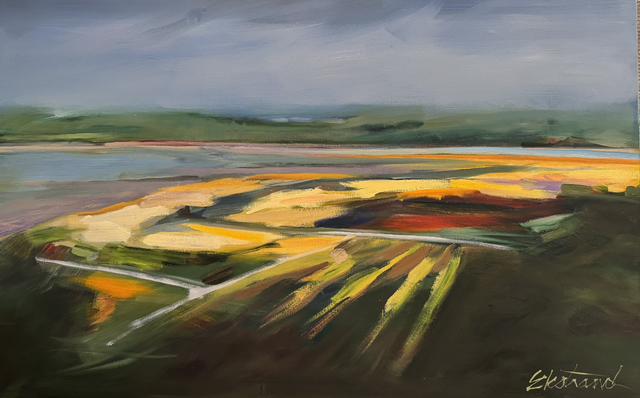
Kris Ekstrand (Petaluma, California): “I’m always looking for a sense of tension within a painting — my own or others’ — a balance of energy which I think is what composition is all about. So, for me, ‘Farming the Shore’ gives me that and serves as an anchor to the nine new paintings in this exhibit. Driving through it, the Skagit Valley appears to be a pretty peaceful place — beautiful and ‘serene.’ True, but it’s also defined by conflicts of water, land and culture. That’s why estuaries interest me so much. These rich, brackish ecosystems lie between open salt water and the Skagit’s deep, fertile farmland, constantly shifting with both saline tides and fresh water. There’s so much to learn about this special place. All I know is that, as always, painting will be my greatest and most generous teacher.”


Devin Michael Roberts (Sequim): “I wish I had a good answer, I don’t have a favorite piece in this year’s show. I almost never have a favorite painting, that reaction is up to the audience or viewer. I also don’t have “concepts” for shows. I create a body of work and each piece is completely unique to what I’m feeling and/or wanting to explore visually.”


Christine Wardenburg-Skinner (Bow): “My show is made up, basically, of drawings that I have done on the dikes and in the fields surrounding Edison, where I have lived for the past 35 years. Somehow, the collection of work creates a composite of place, so there is not really one favorite.
There are four very small drawings of which I am especially fond because they were all done quickly and have the immediacy of simply “being there.” I have several monotypes and larger drawings, but those done with ink, on site, best capture my love of this place.”


Benjamin Vanderwerff (Bow) “Picking a favorite art piece is like picking a favorite child. While I love all of them dearly for different reasons, I do, in fact, have one that stands above the rest for me and points toward where I think my work will head.
‘Fire Creek No. 5’ is by far my favorite piece and is one that anchored many styles together while pushing my visual narrative in a way that was unexpected and unplanned.
Being a plein air focused artist, the experience of creating art in a specific location is directly tied to my process and the result. This piece was my last one made along Chuckanut Road, just off the Lost Lake parking lot.
The graphic and natural appearance of this piece is why it strikes me. It looks highly contemporary, but warm with detail and contrast. The part of the piece that made it come together was an accident: a spray paint layer that burst out instead of being a subtle gradient. This harsh red on the outside of the piece is what I moved forward with, creating an artificial haze, an almost frame-like appearance around the detailed ferns.
With plein air painting, the goal is always to push what I’m creating, both in a visual and technical sense and in the way that I refuse to rest and rely on a sense of style. While I never have an idea of how the work will progress or what that even really means, I know this piece is a slice of that direction, perhaps much earlier than expected, but existing nonetheless.”


Janis Miltenberger (Lopez Island): “My father was a professional horticulturist who, from a young age, instilled in me a love of plants, the wild, and an appreciation for plant growth habits and shapes. That early foundation shaped how I see landscapes to this day.
When I moved to the San Juans in 1984, I was drawn to the isolation, but also to the habitat of the islands. Being an artist required periodic visits to Seattle for supplies and gallery interactions, and every drive through the Skagit Valley transported me. I marveled at the layout of the fields and the trees lining them — it appeared to me like a sketch of lines and colors, all meticulously tended.
The works created and chosen for this Arts Alive! exhibition directly reflect my appreciation and love for both the native and tended plants and flowers and my ongoing connection to this area.”


***
There were two artists we were unable to reach before press time. Here is information about their work provided by ArtsAlive!
Preston Singletary (Seattle) From his artist statement: “My work challenges the notion that Native artists must only use traditional materials. By embracing glass as a storytelling medium, I seek to affirm our presence and identity, reinforcing that Indigenous cultures are dynamic, evolving, and rooted in resilience. Through my art, I strive to amplify Indigenous voices, ensuring that we are seen, heard, and recognized on our own terms.
As my work continues to evolve, I remain committed to exploring the connections between Tlingit culture and contemporary art movements. I have been honored to witness how my journey has inspired other Indigenous artists to experiment with glass and other nontraditional materials. Moving forward, I hope to continue fostering innovation, pushing the boundaries of Indigenous art, and creating work that resonates across generations.”


Suzanne Powers (Anacortes) Artist statement: “Light is what attracts me to a subject, it’s always the light. But, the mood and feeling of a space are what keep me there. Expressing my personal response to that light, color, and form is what my paintings are all about. Nature is my inspiration, its power and fragility. My work is a combination of studio and plein air work, one informs the other. Painting on-site allows me to be spontaneous and responsive to the environment, and to follow a painting wherever it takes me. Studio work allows me to explore technique and creativity. My paintings are a celebration on the natural beauty that surrounds us.”


