
By Luisa Loi
La Conner Community News
Mere minutes away from La Conner’s small and tranquil core, the facilities housing the Port of Skagit’s biggest tenant bustle with the sound of heavy machinery and 85 employees tasked with building some of the largest passenger ferries in North America.
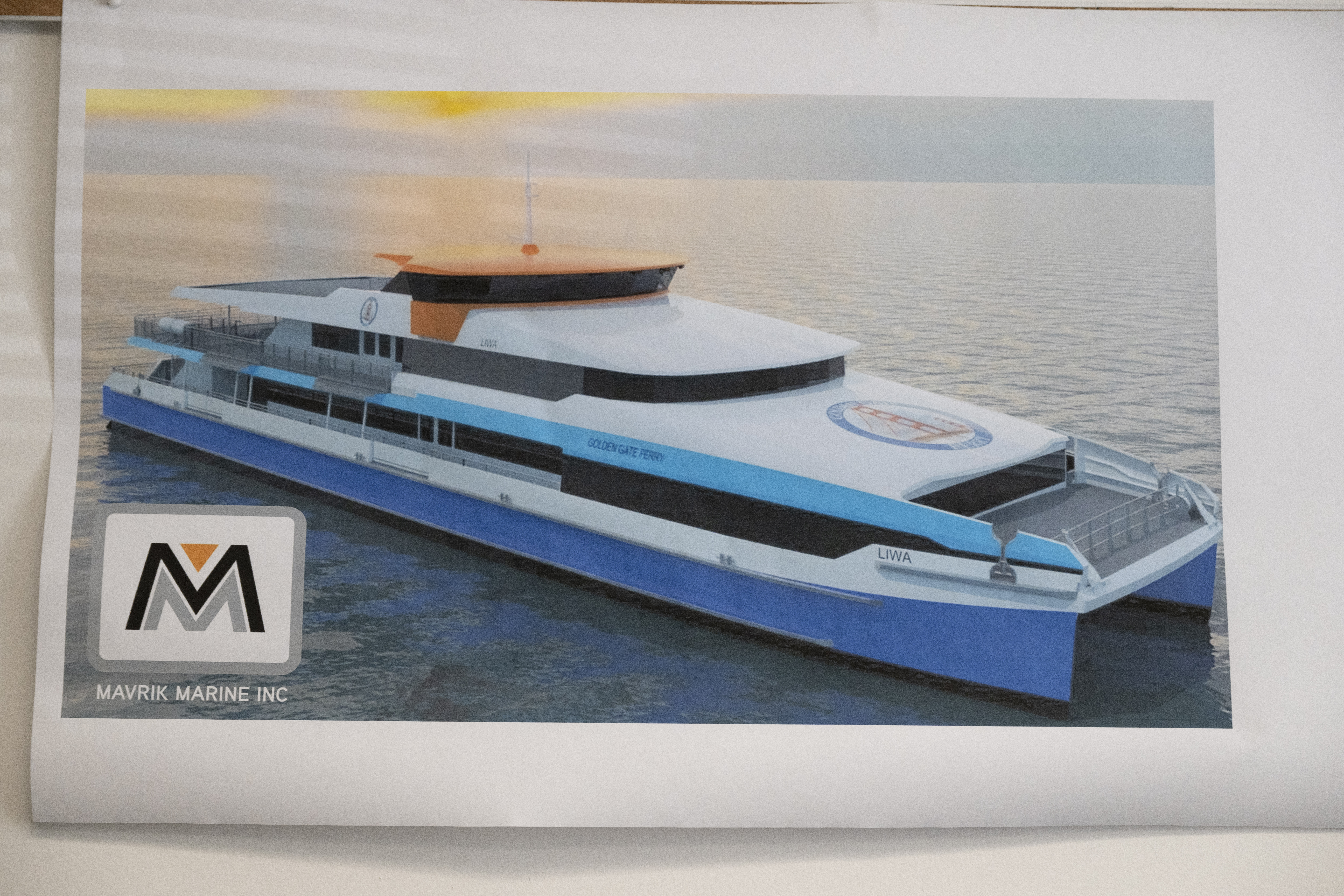
In April, Mavrik Marine Inc. began construction of the first of eight high-speed, three-deck ferries for the Golden Gate Highway and Transportation District in San Francisco.

According to Mavrik President Bailey Shewchuk, these vessels are much larger than the two-deck ones built for the Bay Area’s Water Emergency Transportation Authority over the past few years, with each of the planned boats set to measure 165 feet long, 42 feet wide and 45 feet high.
The ferries will transport up to 500 passengers and 75 bicycles, cruising at speeds of 39 knots.
The Golden Gate Highway and Transportation District is planning to replace all of its seven aging ferries within the next decade, retiring them one by one as Mavrik completes and delivers each vessel to San Francisco.
Last week, Shewchuk took the La Conner Community News crew on a tour of the facilities during the construction of the first ferry’s framework, a phase he likened to creating and putting together the pieces of a giant puzzle with thousands of components.
Inside one of the buildings, workers set large slabs of aluminum — most imported from the Gulf Coast — on a machine that cuts them into the desired shape. On the surface of each piece, which can vary widely in size, the machine prints a code with details pertaining to the piece’s purpose, where it’s supposed to go, and how it should be oriented to fit perfectly with the rest. After that, a press brake bends and curves the pieces as necessary before they are grouped with other pieces for assembly.
While the keel has already been laid, the remaining frames and bulkheads will be placed over the next month. Once that is done, the sheeting of the hull can begin.
After the welding work is completed, the torch is passed to the mechanics, carpenters and electricians. Each hull will have three engines fed by a 2,000-gallon tank of diesel, with a total of six engines per boat, and the vessels will be veined with almost 10 miles of cables, Shewchuk said, adding that the anatomy of the ferry is similar to Mavrik’s previous ferry projects, but on a larger scale.

“For us, it’s just another boat, but the fundamentals of how you build a boat are the same,” he said.
Each vessel is scheduled to be completed within 24 months, with two built at a time. If all goes according to schedule, construction of the second ferry should begin in September, Shewchuk said.
While the burden of tariffs and fuel surcharges fall on the client, Mavrik has had to adapt to longer lead times — or the time between the moment an order is placed and its delivery. For example, while the average lead time for aluminum used to be five days, it has now stretched to 10 to 14 weeks, he said.
When the then 1-year-old business moved from Bellingham to La Conner in 2011, it counted a dozen employees. Today, Mavrik employs 100 people and is planning to hire an additional 20 this summer.
While celebrating how far Mavrik has come, Shewchuk acknowledged the ongoing struggle of finding skilled workers, particularly welders.
“The USA has a shortage of trades people and the problem is getting worse,” he wrote in an email.
Part of the issue is the low enrollment rates in trade schools, as well as the lack of nearby and affordable housing for workers, most of whom have to live in communities along the I-5 corridor, he said.
Still, Shewchuk encourages anyone with “good attitude and aptitude” to apply to work as welders, electrical installers, mechanics and carpenters, promising training, indoor climate controlled facilities, good pay and benefits, and the satisfaction of building a whole boat from the ground up.
Eventually, he said, the hope is to recruit an additional 30 to 40 people and build a new facility to increase production capacity and meet growing demand at a faster pace.
“The Pacific Northwest maritime industry is alive and well, and growing,” he said. “And we’re proud to be a part of it.”
Luisa Loi is a general assignment reporter for La Conner Community News.
