
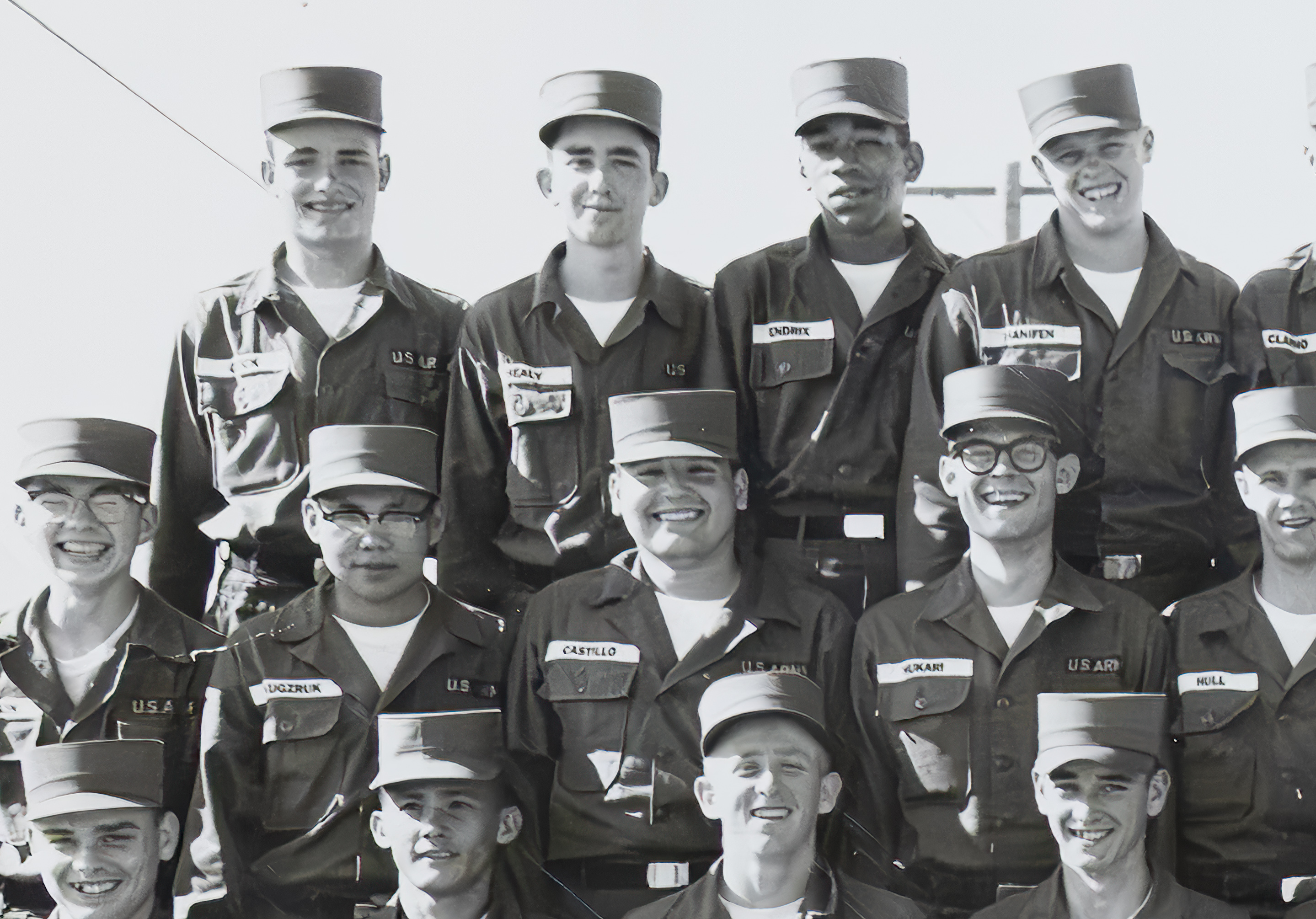
A La Conner High School alum was front row for the Jimi Hendrix experience long before the superstar guitarist, vocalist and songwriter became world famous.
Shortly after his 1961 graduation here, Dick Alvord met the future Rock & Roll Hall of Famer when both were undergoing eight weeks of basic training with the U.S. Army at Ford Ord, California.
Hendrix, who grew up in Seattle, had begun playing the guitar in his early teens. At Fort Ord, during downtime, he would entertain his fellow recruits.
“He wasn’t well-known then,” Alvord recalls, “but you saw that he could really play that guitar.”


Hendrix was eventually assigned to Fort Campbell, Kentucky, for training as a paratrooper.
“That was the last I saw of him,” Alvord says. “He went over to the 101st Airborne.”
Yet it was Hendrix’s musical career that took flight from that point on.
After leaving the service in 1962 — Hendrix said he received a medical discharge after breaking an ankle during a parachute jump — he embarked on a meteoric rise in the music industry.
Before his 1970 death in London due to barbiturate-related asphyxia, Hendrix became the world’s highest-paid rock musician, headlining the famed Woodstock and Isle of Wight festivals. As the face of his band, The Jimi Hendrix Experience, he gained critical acclaim as the greatest instrumentalist in the history of rock music.
Alvord, meanwhile, marched to a far different drummer.
But like Hendrix, he was no stranger to historic events. At the height of the Cold War, Alvord was stationed in Berlin, where the Soviet Union had built a 96-mile wall to prevent East Berliners from fleeing to the West.
Alvord was on duty in West Berlin when U.S. President John F. Kennedy arrived at the divided city in June 1963 to deliver his stirring “Ich bin ein Berliner” speech. During his remarks, Kennedy praised U.S. troops for their role in defending freedom in West Berlin.
“The whole command lined both sides of the street,” Alvord says, recounting the day Kennedy delivered what remains one of the best-known addresses of the Cold War era.
The Kennedy speech was designed to boost morale and show solidarity with West Germans after the Berlin Wall was built.
Urban Berlin was a far cry from the rural La Conner where Alvord was raised, his youth spent working in local farm fields, fishing, boating and playing high school football.
“I did all the normal things you do growing up in the valley,” he says.
Yet, as a soldier, Alvord embraced life in Europe.
“I liked Germany,” he says, looking back across six decades. “Berlin was an interesting city. It has a lot of history and the people really loved Americans.”
Alvord opted to re-up with the Army, specializing in communications. His training led to deployments in Vietnam, where U.S. military action escalated in the 1960s to contain communism in Southeast Asia. Alvord would complete three separate tours in Vietnam, engaged in operations from the Central Highlands to the coast.
After serving overseas plus stateside duty stations such as Fort Hood and Fort Lewis, Alvord closed out his Army chapter and re-entered civilian life, launching a lengthy tenure with recreational boatbuilder Bayliner in Snohomish County.
“Bayliner was a good company to work for,” Alvord says. “They took care of their people.”
Today, Alvord and his wife, Trudy, live in Mount Vernon and are active in the La Conner United Methodist Church and American Legion Memorial Post 91 in Burlington. They enjoy traveling but it’s still Skagit Valley that holds the greatest appeal for the couple.
“It’s always a great feeling when you’re northbound on I-5 at Conway Hill and you see the hills and mountains and the valley below. You can’t beat it,” Alvord says. “Of all the places I’ve lived, it’s the best.”
Nowhere else compares.
Not even when those places allow one to cross paths with either a global music legend or an American president.
Bill Reynolds is a general assignment reporter for La Conner Community News.
