
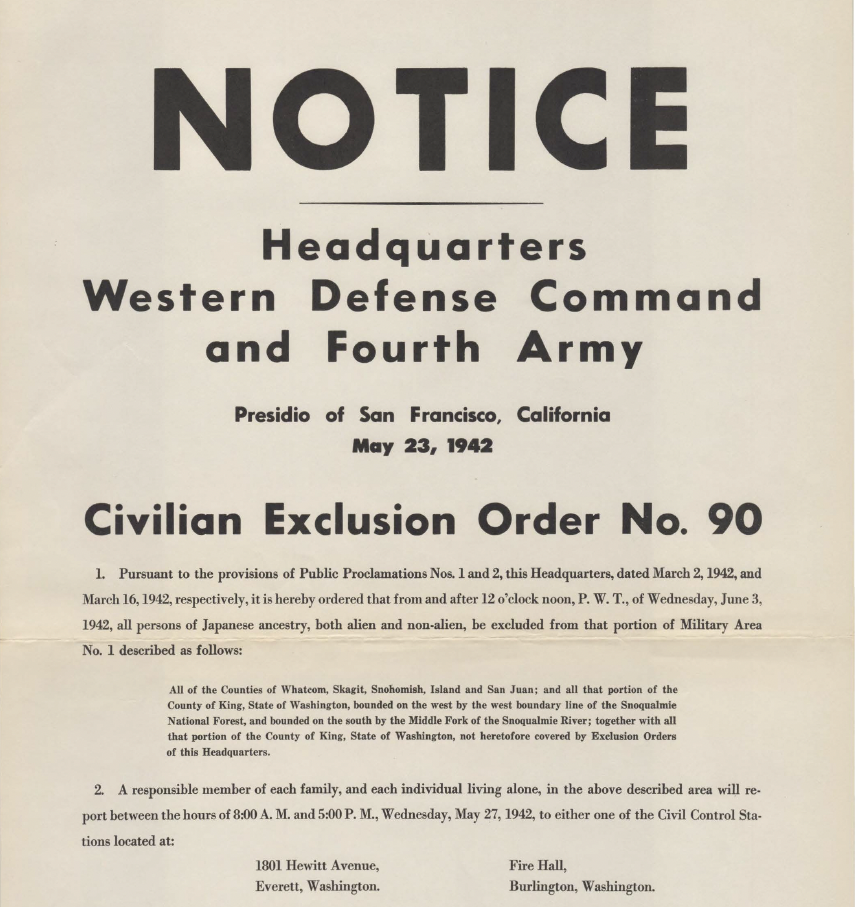
Today is the 83rd anniversary of Executive Order 9066, which authorized the forced removal and incarceration of more than 110,000 Japanese Americans and led to one of the darker chapters in American history. Under the guise of national security, military officials uprooted entire communities — including families in Skagit County, who had only four days’ notice to report for registration before they were sent to America’s bleak incarceration camps.
It’s a period in history we’ve come to equate with war hysteria and unbridled racism. We’re still learning about the extent of the internment; for example, most people still don’t know that the United States interned an entire village of Unangax̂ (Aleuts) in Southeast Alaska or that it ran 16 camps in the Okinawan islands after the war ended. Instead of leaning in and learning more, our countrymen are turning back to the darkness, embracing concepts like mass deportation and border town incarceration camps.
On this anniversary, I urge you to pause and consider a different history — one that we rarely talk about, but one that can lead us to liberation from these ugly impulses. I don’t mean just contemplation of the immense hardships and suffering of the victims, although that is important to understand why we should never demonize people. I mean their resilience, their joy, and their ability to create connection and community in the worst circumstances.
The path to injustice: How internment unfolded here
First, let’s examine how internment came to Skagit County. On March 2, 1942, the U.S. Army issued Public Proclamation No. 1, which created two Military Areas in Washington, Oregon, California, and southern Arizona. Military Area 1 encompassed the western halves of the states and stretched to the eastern foothills of the Cascades, which the military deemed most vulnerable to Japanese attacks or sabotage. Military Area 2 was the eastern halves, which initially were considered safe places for Japanese Americans to live. The military urged a kind of self-deportation eastward, though most families didn’t have the means to up and move.
It wasn’t until May 23, 1942, that the Wartime Relocation Authority issued Civilian Exclusion Order No. 90, which applied to Japanese Americans in Whatcom, Skagit, and Snohomish counties. The order required a “responsible person” from each family to report within four days to one of two locations: 1801 Hewitt Avenue in Everett or the Burlington firehouse. Anyone who had not registered by June 3 would be found in violation of the law. Families had little time to dispose of their homes, businesses, and belongings before being forcibly removed from their communities.
As a little boy in Mount Vernon in the early 1950s, my father didn’t learn this history in school. Instead, he remembers the theaters playing old racist reels of sneaky “J*ps” and heroic American soldiers and a clear dividing line between “us” and “them.”
“We still called them Japs,” he told me. “They attacked Pearl Harbor, we went to war, and our fathers went away to fight them.”
It would have been hard to be Japanese and live in Skagit County then, he said. So many families were adjusting to life with fathers who had wartime wounds — like his father, my grandpa Henry, who lost an eye to a kamikaze in the Philippines. Often, people projected their suffering on the Japanese Americans they encountered in daily life, regardless of the reality that they had nothing to do with it.
Resilience in the face of hardship
How does one survive in a country, perhaps the country of their birth, when it turns on you? When the government strips you of your belongings and property, imprisons you and feeds you strange foods, then leaves you to return to a home where your neighbors are suspicious and wounded?
You might think resilience means setting your jaw against bad circumstances and persevering. That’s definitely part of it, but it’s not the only thing. Eventually, your jaw gets tired. Another element of resilience is finding connection, community, a sense of place, and joy in the worst of circumstances. It’s an important concept that means more now than it has in decades, as the world and our country in particular teeters towards war and isolation.
Japanese internees in World War II — forced to give up their homes and relocate to wartime concentration camps — are an example of human resilience in the worst of times. To weather the suffering of the time, they:
- Created beauty through art. From carving tree branches to practicing calligraphy, internees made time to celebrate the natural world through creativity.
- Created community through organizations and sports. All 10 American concentration camps had baseball fields, and mothers sewed uniforms for their children out of mattress ticking.
- Took pride in the existence they built, like carving wooden name plaques in Japanese and posting them at their doors.
- Continued cultural traditions. My Okinawan grandparents were among the thousands forced into another set of American incarceration camps — the 16 camps for displaced residents of Okinawa in the Okinawan islands. There, musicians fashioned makeshift versions of traditional three-stringed sanshin instruments out of discarded ration cans so they could carry on traditions of singing and dancing.
- Made new good things out of bad circumstances. In Okinawa as well as in Korea, families turned military-issue Spam into dishes we enjoy as specialties to this day.
- Relied on each other and on ancestral ways of knowing and doing. Okinawa was completely demolished with very few buildings standing after the war. Communities came together to build traditional houses with three-stone fire pits for cooking.
Resistance: Standing against injustice
While many endured internment with resilience, others resisted in ways both large and small. Some challenged their forced removal in court, like Oakland resident Fred Korematsu and Seattleite Gordon Hirabayashi, who argued that the internment orders were unconstitutional. Others resisted within the camps, organizing protests against poor living conditions and fighting for better treatment.
In response to the government’s loyalty 1943 questionnaire, for example, Issei (first-generation Japanese immigrants) organized resistance, forcing revisions to the form, including changing its title and softening the loyalty question for non-citizens. Meanwhile, Nisei (second-generation Japanese American citizens) who refused to comply with the Selective Service process faced threats of prosecution under the Espionage Act. Despite these pressures, resistance persisted. Few Nisei volunteered for military service — only 6 percent of those eligible — falling far short of government expectations. Meanwhile, thousands of Japanese Americans, including U.S. citizens, applied for repatriation or expatriation as a means of protest. In some camps, up to 50 percent of Nisei rejected the loyalty questions.
Japanese Americans also resisted by preserving their culture, maintaining their dignity, and rebuilding their lives after the war. Many returned to find their homes and businesses stolen or destroyed, but they rebuilt from scratch, demonstrating their unwavering determination to reclaim their place in American society.
A lesson for today
Eighty-three years later, we must not forget the lessons of both sides of this history. The fear-driven policies that enabled Executive Order 9066 were based on prejudice, not evidence, and they remind us of the dangers of sacrificing civil liberties in the name of national security. Today, as we reflect on the past, we must ensure the injustices endured by Japanese Americans never happen again to any community.
At the same time, we can learn from the resilience of the victims, who persevered and rebuilt communities and connections during and after the trauma of incarceration.
Everyone must remember both of these histories — not just as a cautionary tale, but as an education in resilience from those who endured and overcame it.
