
By Nancy K. Crowell
La Conner Community News
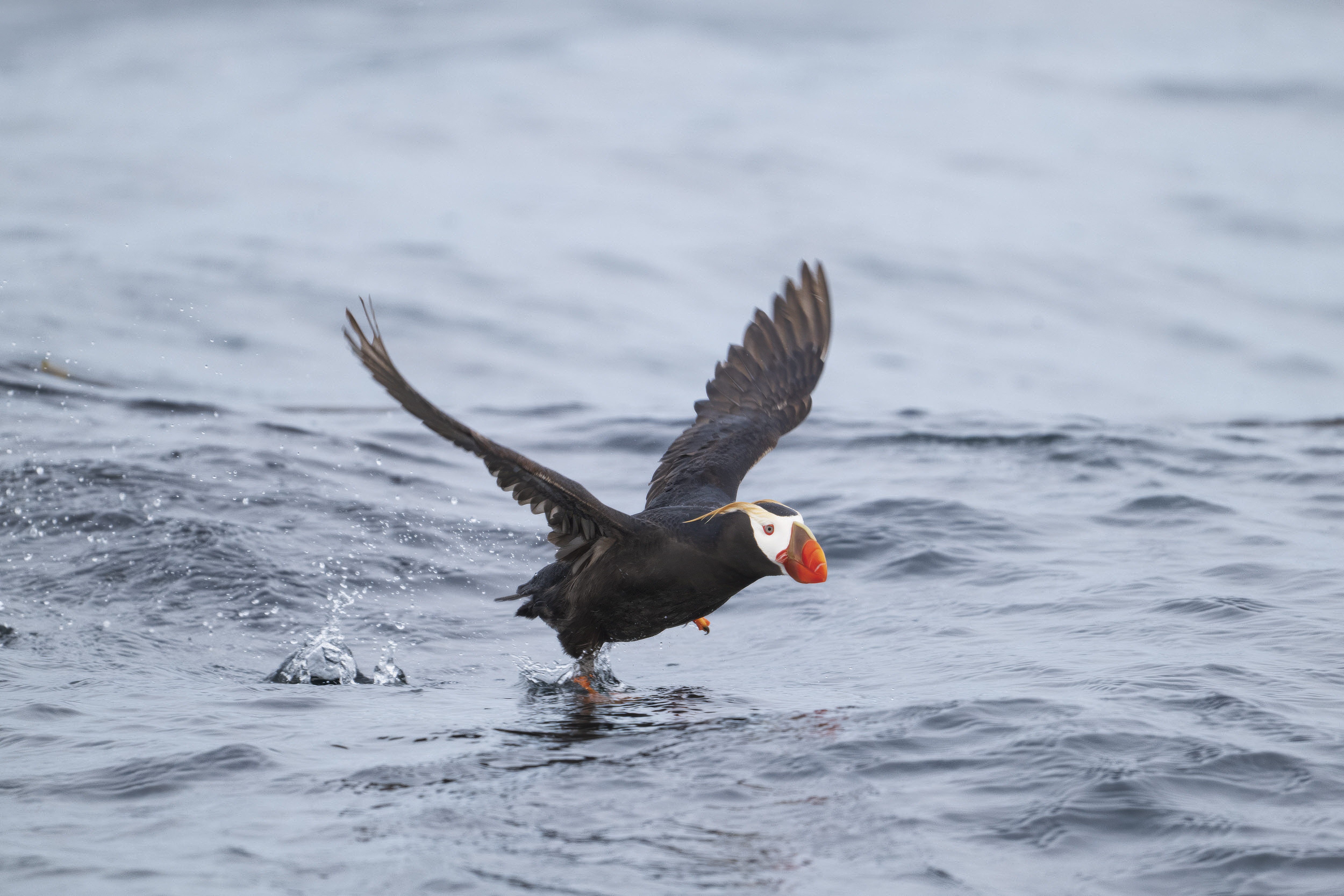
Many people are surprised to learn there are puffins in the Salish Sea. While the seabirds were once abundant here and they had multiple breeding grounds all around the San Juan Islands, their population has fallen 90% in the last decade. Today, the tufted puffins are found only on Smith and Protection islands, which are national wildlife refuges where visitors are not allowed. The birds have state endangered species status.
In 1977, there were 44 active colonies scattered across the Salish Sea, with some 25,000 tufted puffins. By 2010, only 19 active colonies remained, with less than 3,000 puffins. Scientists can’t pinpoint exactly what has caused this dramatic decline, but climate change, loss of habitat due to development and erosion, and loss of food are among the top suspects. Washington Department of Fish and Wildlife crews have been working to eradicate the invasive European rabbits that were introduced to many islands as a food source when white settlers first arrived, as the rabbits destroy habitat the puffins use for nesting.
Because they are endangered and in decline, I make a point to try to go on a puffin tour at least once a season, where I can view them from a boat. If conservation efforts are successful, there may be many more birds in the future. If not, I don’t want to miss any opportunity to see them.


Puffins begin arriving in April and are typically gone by mid-September, with mid-June to mid-July being peak viewing season. Puffins are only on land for a brief period of time for breeding and once they hatch their pufflet (what a baby puffin is called) and it is ready to be on its own, they leave our area.
This year, I went on a photo puffin tour with The Salish Sea School, a nonprofit organization out of Anacortes whose mission is to “awaken curiosity and deepen understanding of the Salish Sea through sea and shore exploration for people of all ages.” Unlike other bird tours I have been on, the Salish Sea School offered a brief talk led by one of their naturalists that introduced us to the history of puffins in the Salish Sea and touched on current conservation efforts before we set sail. This is particularly useful for visitors who may never have been to our area at all and don’t know anything about alcids — the bird family puffins are classified in. This includes auks and murres as well. Other alcids commonly seen on puffin tours include rhinoceros auklets, common murres, and marbled murrelets (also endangered). Most tours I have been on have a naturalist or birder on board to answer questions and help spot these small, bobbing birds.
One unusual visitor who is not native to our area is a horned puffin that has been spotted among the tufted puffins the past few years. I have been lucky enough to see and photograph this bird. Believed to be a female, local scientists monitoring the nests and tracking the lives of these birds suspect she has mated with a male tufted puffin — a first, if true, in puffin research.
To set expectations for those wanting to see puffins here, first, understand that there are only a few breeding pairs left in the Salish Sea area compared to in the past. All but one pair breed on Smith Island, which is protected. From mid-June to mid-July they are still in breeding plumage and are catching fish to feed their pufflet. They start losing their colorful breeding plumage by mid-August.
To get to Smith Island you should look for either a puffin-specific boat tour, or wildlife tours that go to the area where puffins can be seen.
Puffins are small birds and spotting them on the water, especially if the water is choppy, can be challenging. In my experience, the tour boat drivers will do everything possible to get everyone on the boat a good view. I have never been on a tour when I did not see at least one tufted puffin, although spotting the horned puffin has been hit or miss.
The boat ride out to the islands can take a while, and if you’re prone to seasickness you should consider going on one of the larger boats. Smaller boats maneuver more easily and can often travel at higher speeds, but none of that means anything if you’re queasy. It’s also much colder on the water than on land. Bring warm clothes to guarantee your comfort, even if it’s a warm and sunny day.
Here is a list of puffin and puffin-related tour possibilities:
Dedicated Smith Island puffin tours
- The Salish Sea School – dedicated Puffin Discovery and Puffin Photography trips.
- Skagit Guided Adventures – seasonal Smith Island puffin cruises.
- Outer Island X – dedicated birding trips to Smith Island.
Wildlife tours that frequently encounter puffins
- Deception Pass Tours – Minor Island Marine Mammal Tour (excellent chance of seabirds, including puffins when they’re present around Smith/Minor Island).
- Puget Sound Express – seasonal puffin cruises to the Smith/Protection Island area.
- San Juan Cruises – seasonal bird cruises targeting Smith Island.
Timeline
- Late May–June: Courtship and nesting activity
- July: Adults carrying fish to chicks (arguably the best photography)
- August: Puffins still present, often excellent viewing
- Early September: Some birds remain, but numbers begin to decline.
Nancy K. Crowell is the photo editor for La Conner Community News.
