
By Luisa Loi
La Conner Community News
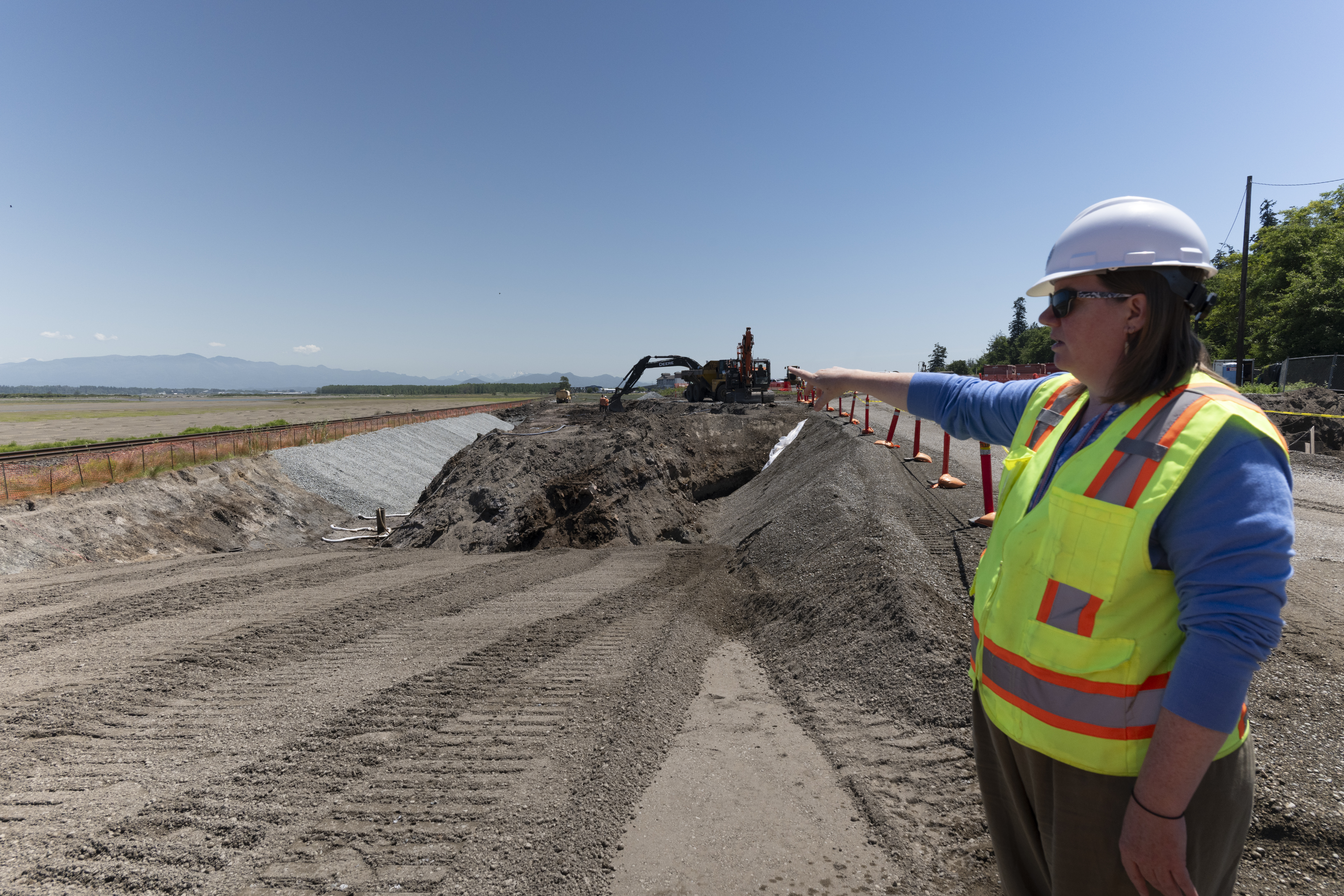
Against the backdrop of Mount Baker and the vast stretches of mud left bare by the low tides, crews and bulldozers cut through the decades-old lasagna of trash, chemicals and dirt that remains from the old Whitmarsh Landfill on March Point Drive, Anacortes.
Two decades after the site — located near the largest heronry in Washington and bordering the Swinomish Indian Reservation — was identified as a source of pollution into Padilla Bay, the remediation work kicked off in late March and is expected to conclude by the end of October 2026, according to Project Manager Margo Gillaspy, who also oversees the Skagit County Solid Waste Division.
Once the nearly $14 million project is completed, the property will look like a grassy field, its surface concealing the thick cap that will seal the low levels of contaminants found away from the outside world.
The project is funded through a mix of settlement funds, private insurance and grants from the state Department of Ecology — which approved the plan and is contributing for about half the costs, Gillaspy said, adding that no Solid Waste funds are going towards the cleanup.
Decades of dumping
Between the 1950s and 2011, this roughly 15-acre property turned into an unregulated roadside dump, then a burn dump and sanitary landfill operated by the county, then the site of a saw mill that produced 10-feet-tall mounds of wood debris on property that was partially leased from the Washington State Department of Natural Resources, according to Skagit County.
The county covered the landfill with a 2- to 3-foot layer of soil before its closure in 1973, and the mill was demolished in 2022, eight years after the Department of Natural Resources removed 44,000 cubic yards of wood waste from the site.
As evidenced by the fragments of glass and plastic mixed with the dirt, the landfill was never completely cleaned up. And while there has not been strong evidence to prove this, there is concern that Shell Oil Company and Texaco Inc. may have contributed to the concoction as well by dumping their own industrial waste from the nearby oil refineries, Gillaspy said, mentioning the discovery of “patches” of oily materials at the site.
Samples collected from the soil and groundwater at Whitmarsh Landfill showed the presence of pesticides, metals, polychlorinated biphenyls (or PCBs), total petroleum hydrocarbons, volatile organic compounds and semi-volatile organic compounds, according to a project report.
Though she couldn’t speak on the exact risks posed by the contaminants at the detected levels, Gillaspy said they can accumulate in the body, especially PCBs, which the Environmental Protection Agency listed as probable human carcinogens.
A cap on the landfill should keep people and animals from being exposed to the contamination and prevent rainwater from spreading the contaminants into the environment, Site Manager David Horne from Ecology wrote in an email, adding that workers are updated daily about the hazards and wear air monitors to ensure they are not “in a hazardous environment.”
When asked about the contaminants seeping through the bay mud that the landfill sits on, Gillaspy said the mud is “tight” enough that it doesn’t appear to be impacted.
“We’re not seeing a lot of exchange of that contaminated groundwater down into any deeper aquifer,” she said.
While a complete clean-up was among the possible remediation options, the idea was discarded due to its high price estimate of $80 million, which Gillaspy believes could have reached $100 million in today’s economy.
“It just didn’t seem worth it for the payoff,” she said.
Encapsulating the waste
As of last Thursday, crews from the county’s Public Works Department and Strider Construction had already started excavating at the entrance of the site and were busy digging the solid waste adjacent to the BNSF railway (which keeps seawater away from a large portion of the landfill), moving it towards the center of the property. An underground concrete wall that is meant to prevent water from reaching the landfill was also taking shape on the other side of the mound.
Meanwhile, a series of pipes collected any contaminated groundwater that flowed from the landfill’s excavated edges, pumping it into an on-site treatment system that can safely discharge the water back into the environment, Gillaspy said.
The project has already encountered some challenges, she said. For example, the first water sample from the treatment system did not meet water quality standards, which meant the treatment process needed to be intensified, thus delaying progress.
Biologists also monitor the site to ensure nearby birds, especially herons, are not showing any signs of distress — which she said has not been the case so far.
Once the landfill material is piled up and isolated from the surrounding area, crews will cover the mound with a 3-foot-thick barrier comprising a layer of sand, a geosynthetic clay liner anchored to the ground, and layers of sand, gravel and soil topped by grass.
The gravel is meant to discourage animals from digging and damaging the cap. Trees are also a no, Gillaspy said, as their roots could perforate the synthetic barrier. Still, she added, the clay in the geosynthetic liner is meant to seal any openings upon contact with water, swelling up around roots or other objects. Furthermore, the clay was enhanced to be resistant to seawater intrusion in the scenario of a large king tide or sea level rise.
While the cap is not meant to be replaced, the site will continue to be monitored for at least five years to ensure its effectiveness, she said. The site is not planned to be used as a park or open to the public.
Luisa Loi is a general assignment reporter for La Conner Community News.
