
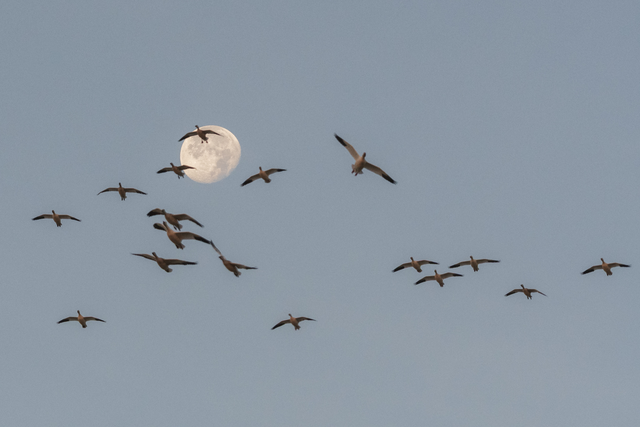
It’s migration season. While you may be aware that snowgeese and swans move en masse from our valley, other birds also migrate along our busy Pacific flyway and there are easy things you, as a homeowner, can do to help protect them as they pass overhead.
Most birds migrate at night when they are safer from predators and the air is calmer. In fact, according to the Cornell Lab of Ornithology, 80% of migrating birds navigate at night.
They navigate by stars and other natural cues. One of the biggest threats to their migration is light pollution. They can become disoriented by bright lights at night and go off course or, if in a city, run into buildings. More than 1 billion birds a year in the United States are killed by hitting glass.
Living in a rural area seems like a safe place for birds, but in fact many people leave lights on all night and light pollution has been steadily increasing in our area.
Turning off lights between 11 p.m. and 6 a.m., using warm temperature lights, or even different colored lights, and aiming necessary lights down at the ground are simple things we as humans can do to help prevent these disruptions.
Now is the time to be paying close attention because billions of songbirds are migrating and thanks to new technology, everyone has access to forecast migration patterns. Peak migration in our area is currently predicted to go through May 8.
In fact, if you sign up for alerts for your area at birdcast.org, you can use their tools at birdcast.org/migration-tools to receive forecast alerts, watch the migration in real time, and get information specific to your area.
To learn more about specific migrating species, visit explorer.audubon.org, which tracks 450 species.
Nancy K. Crowell is the photo editor for La Conner Community News
