
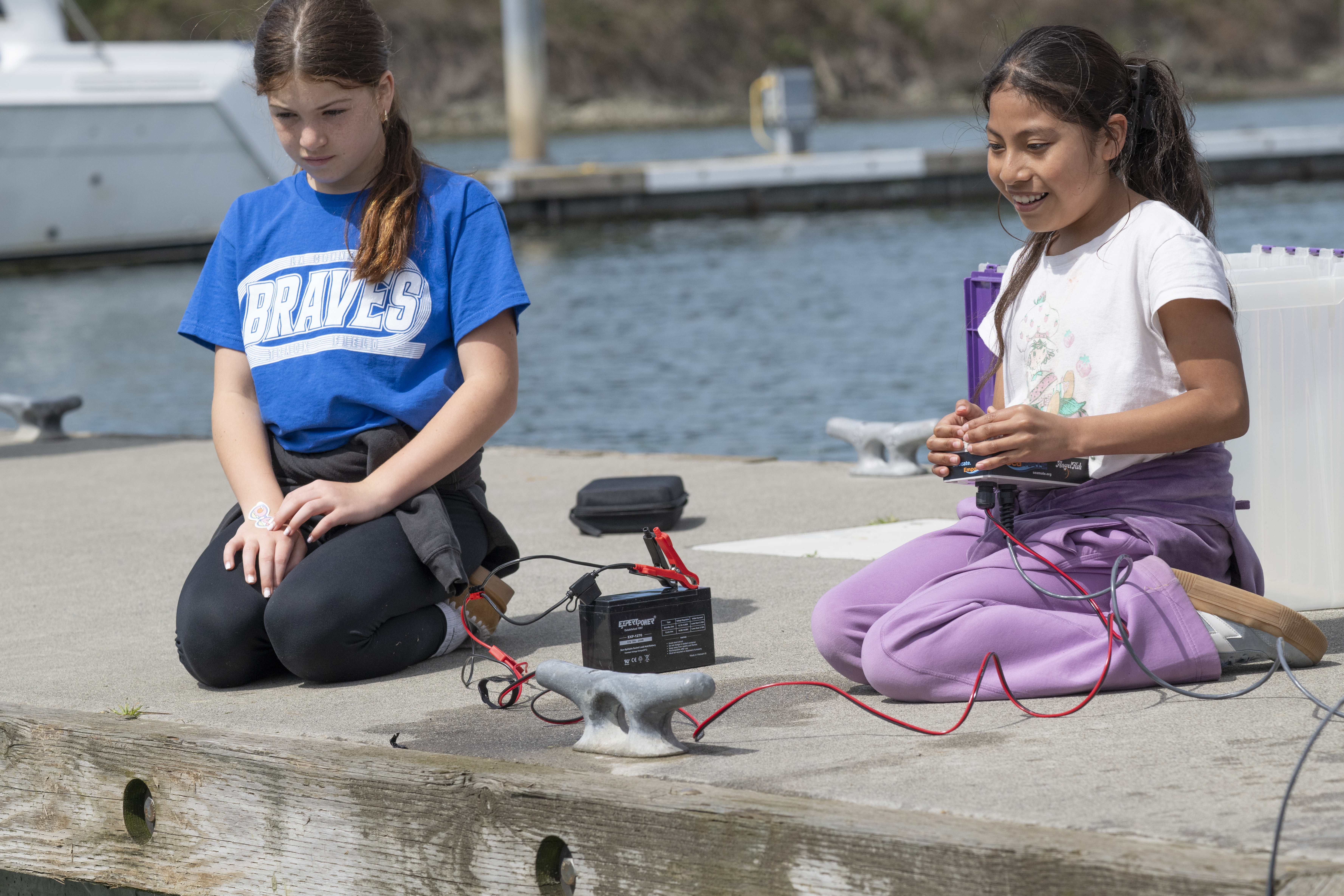
Having long ago mastered their ABCs, La Conner fourth and fifth graders are now working on their ROVs — as in remotely operated vehicles.
The students, working in groups over the course of a couple weeks, designed and built from kits their ROVs, basically submersible robots, using a wide range of materials. That hardware included, but wasn’t limited to, PCV pipes, batteries, motors, controllers, tether cables, cameras, foam, electrical tape and alligator clips.
Then, last Friday, the kids were given the opportunity to test their ROVs in the water off G Float at La Conner Marina.
La Conner Elementary School Principal Marcus Knowles, Swinomish Director of Education Loran James, teachers, parents and adult volunteers accompanied the students for the launchings, which reinforced a slew of academic skills.
“The thing about working with robots,” Knowles said as students approached La Conner Marina’s north basin, “is that it combines everything that’s important in education — critical thinking, creativity, problem-solving and teamwork.”

Teacher Cammy Alumbres agreed, noting how the ROV project blends science and social studies curricula, with the former helping resolve issues raised by the latter.
“There’s an environmental component to this unit,” Alumbres pointed out. “They (the students) can learn how technology can help clean our waters. We know there’s a lot of plastics out there. So, this shows that we can use technology to solve the problem.”
James, a veteran tribal fisher and skilled boatman, took the lead in instructing students on safe conduct around water, how to maneuver the ROVs, and in using their camera viewfinders.
“It’s a live feed and they’re seeing everything in real time,” James said of the camera system. “They can see what’s happening on the bottom.
“They learned that crabs don’t like the camera,” he chuckled. “You can see the crabs pinch at it.”
Students took turns driving the ROVs and looking through cameras.
“It’s like a TV show!” exclaimed fourth grader Sydney Trajano as she peered through a lens at the underwater images.
At one point, a section of foam used to aid buoyancy dislodged from one of the ROVs. James showed the affected student group how to position its ROV to recover the wayward piece.
Ultimately, it was the day’s breeze and current that guided the foam back to the dock.
“The weatherman helped us,” James joked.
Students promptly began work to reattach the foam, which Alumbres noted was part of the learning process.
“You guys are being engineers right now,” she said. “You’re figuring it out.”
Alumbres said that James has participated in the Western Washington University CREST (Culturally Responsive Elementary Science Teaching) Grant program, which promotes hands-on and culturally relevant learning experiences for students.
“It’s great to have Loran involved in this,” she said.
Alumbres said detailed classroom instruction and trial ROV runs in a temporary pond on campus were also part of the lesson.
Bill Reynolds is a general assignment reporter for La Conner Community News.
