
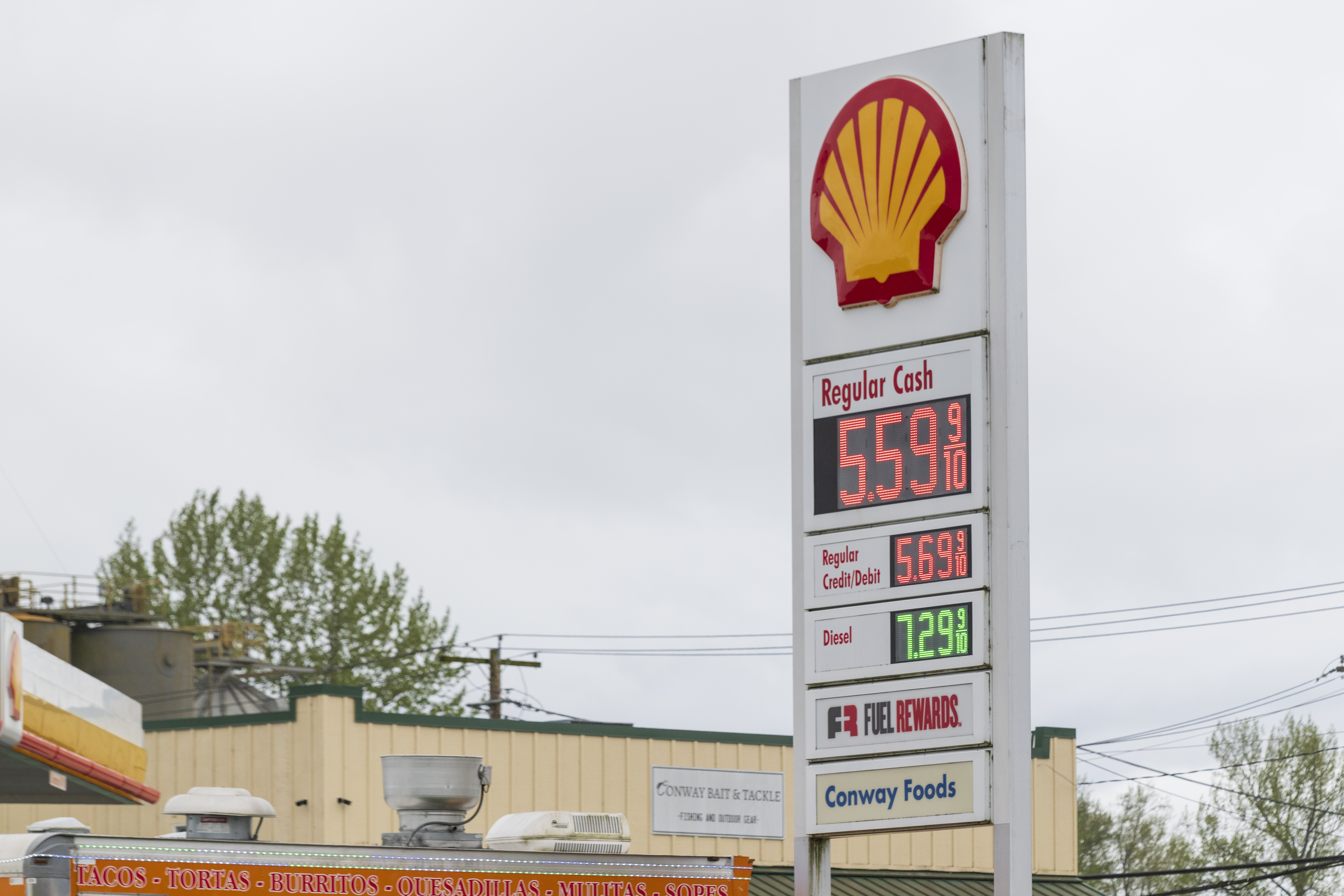
As fuel costs skyrocket amid the Iran War, the impacts are felt deeply among Skagit’s most vulnerable and the agricultural community, which were already sinking deep into the country’s worsening affordability crisis.
In Washington, diesel prices reached an average of $6.96 per gallon on Friday, breaking the record that was set just a few weeks earlier. While regular fuel prices remain below their peak, a gallon of unleaded gas averaged $5.39 on Monday — just 16 cents under the June 2022 record, as reported by the Seattle Times.
To some, these times of economic uncertainty are a throwback to other major crises from the 20th century.
Choosing between gas and basic necessities
While the volunteers packaging and distributing food at the La Conner Sunrise Food Bank don’t ask questions pertaining to their clients’ financial situation, some of the seniors receiving assistance have shared that this “nervousness” reminds them of growing up in the Great Depression, Director Arin Magill said.
Despite what Magill said is an assumption that La Conner is an affluent community, the food bank has seen working families struggling to make ends meet, seniors skipping meals because Social Security is not enough to cover monthly expenses or keep their pets fed, and a significant increase in calls from nervous inquirers who have never received food assistance and are now forced to step out of their comfort zone to get help.
Gas and grocery prices seem to be the main drivers of these trends, Magill said, mentioning that more clients have been picking up their boxes of food on foot to save on gas.
Every week, Sunrise Food Bank serves on average 130 households, 75% of which she estimated are based in La Conner. While the number of clients has remained around 400, Magill believes the number of clients — adults and children — living in RVs has doubled in the span of a year.
Surging costs also weigh heavily on the food bank, which has been forced to purchase more food to compensate for the drop in donations from major hunger relief organizations like the United States Department of Agriculture, Northwest Harvest and Food Lifeline, Magill said.
In March, for the first time since the pandemic, Sunrise resorted to a fundraiser, raising more than $52,000 — $20,000 of which from a local donor.
Magill expressed her appreciation for the donations from community members and local farmers, which she said have allowed the food bank to continue operating.
While Sunrise welcomes donations of food and other non-food necessities, the organization can triple the value of each dollar donated by purchasing in bulk, so monetary donations tend to have the most impact, she said.
Helping Hands Food Bank, which serves the Swinomish Reservation, could not respond to a request for comment by press time.
Impacts on farming
Don McMoran, director of the Washington State University Skagit Extension, said the costliness of diesel is impacting the profitability of farms in Skagit and around the country, though the severity of the impacts depends on what the operation produces.
At the same time, farmers are contending with rising fertilizer costs, an unfortunate situation that McMoran called “a double whammy.”
While 20% of the world’s supply of oil and natural gas passes through the Strait of Hormuz, where the weekslong blockade on shipping traffic has disrupted global supply chains, 30% of the world’s fertilizers are shipped through the waterway, according to the Associated Press and USA Today.
According to La Conner berry farmer Dean Swanson, the great majority of farms in Skagit are not organic, thus could feel the additional hit from the fertilizers — with some brands becoming 40% more expensive, according to Farm Journal.
McMoran said this is a difficult situation because he predicts that many hardworking farmowners will have to ask for loans to make up for low profits. Despite the fact that running a farm has become more expensive, commodity prices are comparable to what they were in the 1980s, he said.
Swanson recalled how diesel was “extremely inexpensive” in the spring of 2025, and that today’s price surges came as a complete shock to him. While he expects to be less impacted than other local farmers (whose farms he said may cover more acres, use bigger machinery and require more work), he feels deeply for them, not anticipating prices going down during this planting season.
While his tractor has a capacity of 300 gallons of diesel, other farming operations may need to refuel equipment with the capacity of thousands of gallons, which can be consumed quickly when preparing the land for a new crop. For comparison, the average car’s gas tank holds between 12 and 16 gallons of fuel.
“It’s not like you’re going to Portland for the weekend,” he said. “It’s like you’re going to Portland everyday for a month to get that field work done.”
Faced with tough times, many farmers will have to make sacrifices, McMoran said.
“We’ll probably see the farmers doing less passes and less tillage in their fields to try to save on fuel,” he said.
McMoran anticipates some farms will shut down. One positive aspect of this situation, he said, is that it may pave the way for a new era where agriculture is more prosperous for those who can stay in business.
Both McMoran and Swanson likened the current situation to the 1980s farm crisis, where roughly 300,000 farms defaulted on their loans, farmland in some states lost up to 60% of its value, and nearly 300 agricultural banks failed in six years, according to LegalClarity.org.
Swanson said he was upset about the Iran War, a sentiment he said other farmers he knows have shared as well.
“I don’t know anybody who could say ‘I’m not upset about it,’” he said.
While not indicating a particular cause, McMoran said he believes the issue is the culmination of failures at both the state and federal levels.
“There’s a lot of places to point fingers,” he said. “I think the issue is, nobody wants to step up and really claim the errors in their judgement.”
Luisa Loi is a general assignment reporter for La Conner Community News.
