
Experts from the Swinomish Tribe and beyond have teamed up to uncover the secrets of the state’s most profitable fishery: Dungeness crab.
While the fishery contributes roughly $70 million — or more — to Washington’s economy every year and is a hugely important economic driver in the Tribe, several questions about the crabs’ biology, numbers and how they are affected by water conditions have yet to be answered with certainty in the Puget Sound region.
“It is an extremely valuable fishery, and we are way behind on the science compared to salmon,” said Julie Barber, senior shellfish biologist for the Swinomish Indian Tribal Community’s Fisheries Department. “We don’t even have the basic biological information that we need in order to run a stock assessment.”
While the Tribe has been conducting its own research in Swinomish’s usual and accustomed territory, it has also been working collaboratively with other experts from tribal, state and federal governments, as well as nonprofit organizations, universities and communities with the goal of producing data that can be used to manage this resource sustainably and ensure it can continue to feed communities for generations to come.

Restarting Dungeness research
This partnership is known as the Pacific Northwest Crab Research Group (PCRG), which began in 2018 to address gaps in knowledge of crabs — mainly Dungeness — and provide fishery managers with data they can use at their discretion, according to Program Coordinator Emily Buckner.
While this isn’t the first attempt to understand this species locally, it represents a revival of such efforts since the 1980s or 1990s, she said.
When harvesting any species, knowing how many critters are out there can be helpful in setting catch limits in a manner that does not deplete the population. Since an accurate method to predict Dungeness crab numbers in the Salish Sea has yet to be developed, fishery managers have been using commercial catch estimates from previous years to decide how much catch to allow in the coming year, Buckner said.
The downside of this method is that any significant population changes would only become apparent when crabbers pull their pots out of the water, she said.
It is also important to note that Dungeness crabs that are allowed for harvest must be male adults of legal size. In the Puget Sound, that means the carapace must be 6.25 inches wide at minimum, according to the Washington Department of Fish and Wildlife.
With these things in mind, researchers are trying to find a way to forecast adult Dungeness populations — something that biologists have been able to do with returning salmon.
Honing the science, one larvae jug at a time
In the quest for empirical clairvoyance, the Tribe’s shellfish team and PCRG have deployed numerous light traps around the Salish Sea. According to Barber, these devices consist of a modified water jug with a float on top and, as the name suggests, a light that lures the larvae into the enclosure through a funnel.
The Tribe, which Buckner said established the protocol that PCRG uses for its own light trap use, deployed three traps that are checked by Swinomish staff three times a week and by a group of Salish Sea Stewards citizen scientists once a week, Barber said.
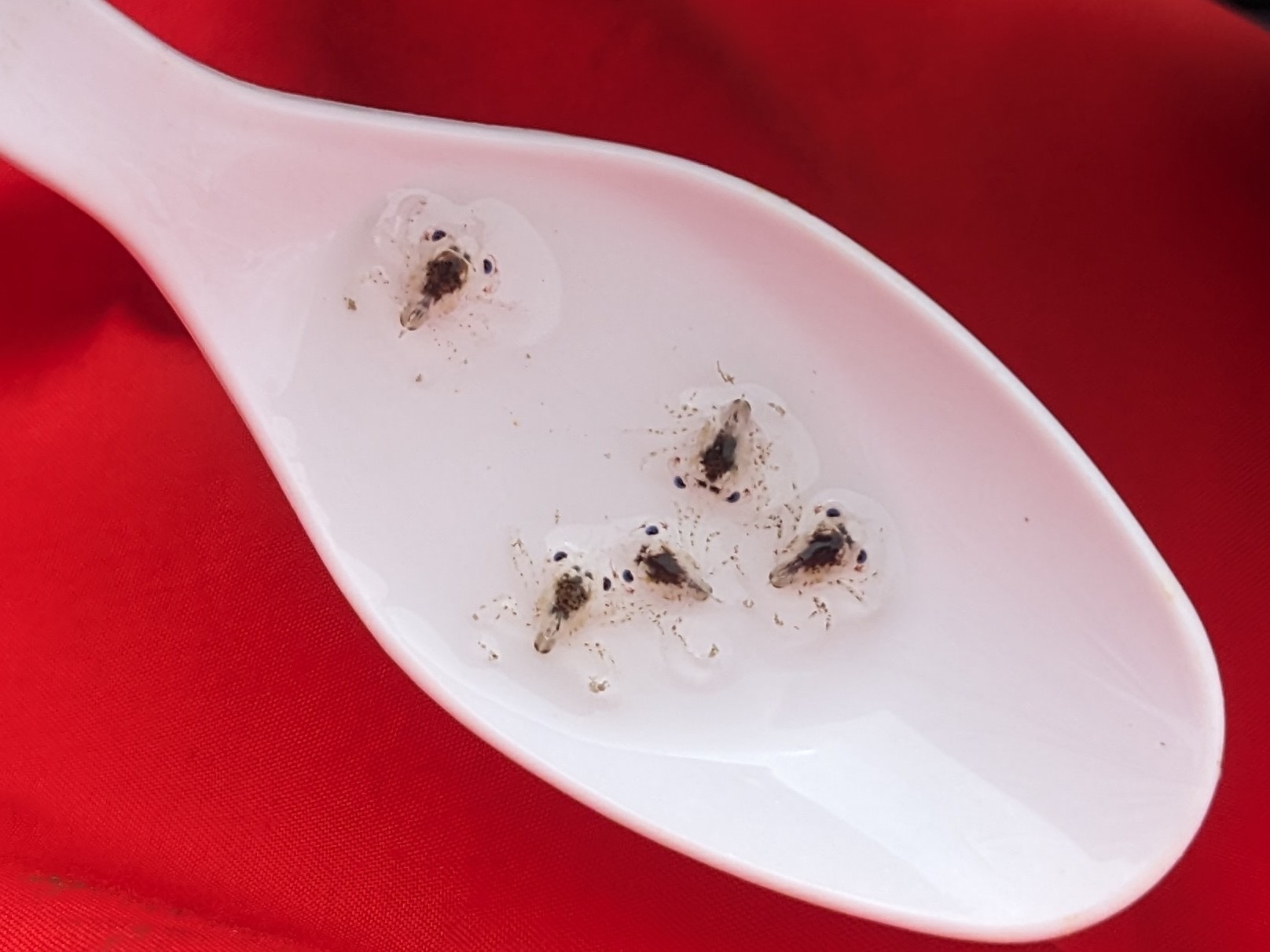
Typical catch numbers range in the hundreds, though on some occasions a trap might contain up to an estimated 30,000 larvae, or enough to fill a five-gallon bucket, Buckner said.
“It’s awful,” she said when asked to describe the sight of a bucket filled with wiggling baby crabs — which are so underdeveloped that one could say their legs look like sparse dots and their bodies like dark Rorschach inkblots.
Once they are collected and counted, the great majority of the larvae — or “megalopae” — are returned to the water, while up to ten specimens are preserved for genetic testing, according to Barber.
While researchers at the University of Oregon are able to predict future commercial catch of the Dungeness crab fishery along the Oregon coast with one single trap, Barber said it isn’t that simple in the “oceanographically complex” Salish Sea, where Dungeness crabs appear to differ from their open coast counterparts.
For example, while open coast Dungeness crabs normally take four years to reach legal size, a laboratory study conducted by the Tribe and published in 2024 suggests that some Salish Sea crabs might take longer to do so, Barber wrote in an email to la Conner Community News.
“Regarding the relationship between larval abundance and adult biomass, Swinomish is not quite to a phase where a lot of results can be provided to co-managers for their decision-making,” she wrote. “Science isn’t a fast process … It can take us time to learn but we always are interested in improving our predictors of adult biomass and our biological understanding of this important species.”
Origin and temp could impact crab growth
The idea that open coast and Salish Sea crabs are different seems to be further supported by research led by James Dimond, a marine biologist at Western Washington University.
Dimond has been collaborating with the Swinomish Tribe and PCRG since 2021, extracting DNA from the samples they submitted and then submitting it to a commercial lab where the genome of each sample is sequenced.
While these studies are still underway, the findings so far suggest that Dungeness crab populations have “relatively strong” connectivity compared to many other marine species in the region, while also showing distinct ancestries.
In an email to La Conner Community News, Dimond explained that Dungeness crabs show strong coastal ancestry all the way into the eastern Strait of Juan de Fuca, and that this ancestry seems to weaken north of the San Juan Islands and south of Admiralty Inlet.
“This means that areas like Port Angeles, Port Townsend, the southern San Juans, and the west side of Whidbey Island are strongly connected with the outer coast, while areas like Bellingham Bay, Birch Bay, Hood Canal, and the central and southern portions of Puget Sound are not as well connected,” he wrote.
Furthermore, the larvae arriving from the outer coast before June tend to be significantly larger (7.5 millimeters in length) than the larvae originating within the Salish Sea and that arrived in the later, warmer months (which are instead 5 millimeters long), Dimond wrote.
While this seems to be in part due to genetics, it also appears that the early arriving larvae are larger because of the colder temperatures during their development, suggesting that they grow faster into harvestable adults as a result, perhaps by a year or more, which he said caught him by surprise.
“I’m excited about these findings,” he wrote. “I feel like we’ve gotten some new insights about things that researchers started working on decades ago.”
What this means for crab health
There are still many unknowns when it comes to what consequences these potential growth patterns could have, Barber said, adding that smaller and slower-growing crabs may be at greater risk of being cannibalized or eaten by other predators. To Dimond, these findings alone don’t seem to indicate anything alarming about the crabs’ health, and he is more worried about the potential impacts of climate change on these creatures.
Talking to a class of students attending the Salish Sea Stewards program on Feb. 17, Barber cited the mysterious collapse of the Dungeness fishery in the South Sound and the equally puzzling failure of the fishery at Hood Canal that has been taking place.
“It makes scientists nervous to not understand why fisheries are not doing well in some areas,” she said.
Buckner said these events have motivated many researchers to look into what’s going on to prevent that from happening in other areas. Perhaps, she said, the cause isn’t overfishing, but the natural geography of that part of the sea that doesn’t allow for water to “flush,” leading to a decrease of oxygen levels and less hospitable conditions. Or perhaps it’s the result of intense human development.
All of these are important possibilities to explore in order to continue building long-term resilience for this fishery.
Luisa Loi is a general assignment reporter for La Conner Community News
