
Washington state officials are working to interpret Friday’s federal court rulings that ordered the continuation of SNAP food benefits despite the ongoing federal shutdown. The state Department of Social and Health Services (DSHS) said it is awaiting guidance from the U.S. Department of Agriculture’s Food and Nutrition Service to issue benefits “as soon as possible.”
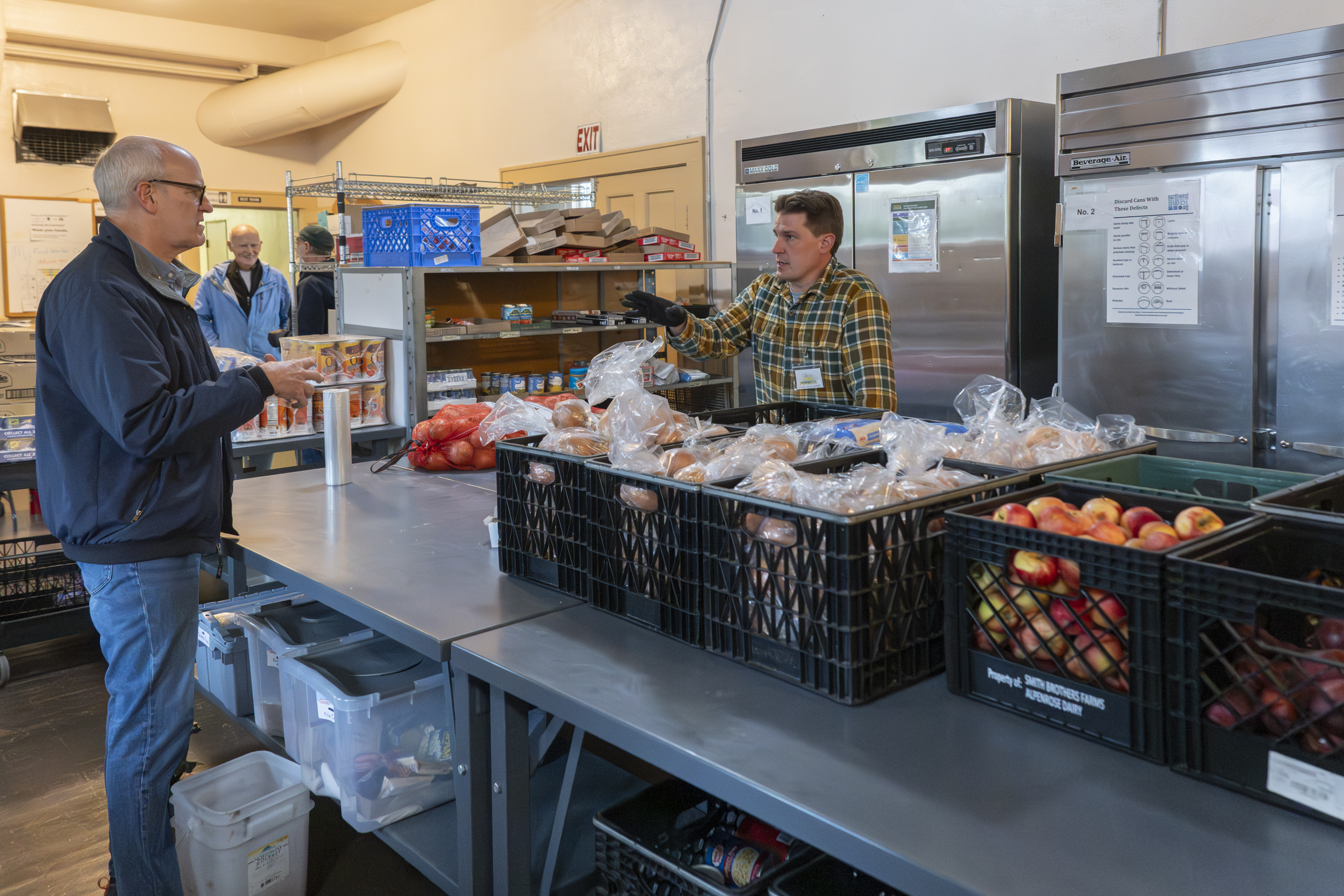
The court ruling came just as U.S. Rep. Rick Larsen finished a Friday morning tour of the La Conner Sunrise Food Bank, where he discussed the importance of the SNAP contingency fund and the toll the shutdown has taken on local families.
“The administration has the money,” Larsen said. “They need to use it. People need food.”
Local need high
Roughly 15,744 low-income Skagit residents lost access to food stamps on Friday as a result of what is close to becoming the longest government shutdown in U.S. history.
The loss of Supplemental Nutrition Assistance Program — or SNAP — benefits came as local food banks were already coping with the cut of federal and state food security programs in recent years and growing demand from the community, said Elizabeth Jennings, director of community engagement at Community Action of Skagit County. The nonprofit connects low-income people to food, housing, education and employment resources and helps distribute food to local food charities.
Larsen’s visit coincided with growing community concern about the impact of the shutdown on families dependent on food aid. He met with Food Bank Director Arin Magill, who described how the pantry serves more than 130 La Conner-area households each week with the help of 40 volunteers.
“We actually say this is a food bank family,” Magill said, her voice breaking slightly.
Volunteer Chris Johnson, a potter and La Conner Schools employee, told Larsen that on the most recent distribution day, “cars were lined up all around the block” to receive food. Larsen said that with SNAP benefits delayed, more people may soon depend on their local food banks.
“With all the uncertainty, I think we’ll see a surge,” he said.
Pastor Johnny Dean of Inspire Church in Swinomish said he expects an influx of clients in need of food assistance from Helping Hands, the food bank that operates at the church.
Food donations down
Prior to Oct. 31, Sunrise Food Bank was receiving fewer supplies than normal from Northwest Harvest and Food Lifeline, two hunger relief nonprofits that distribute food to charitable organizations across Washington. The reduction was particularly dramatic with the U.S. Department of Agriculture, which recently supplied 75% less food to the food bank, Magill said.
“It’s definitely under the good graces of our community members that we’ve been able to serve,” she said, praising the community members who have stepped up to volunteer and make donations, as well as the local farmers who have donated part of their harvest.
“More than ever before, just kind of relying on each other within our own community and not necessarily the government or large entities is the way that we’re able to survive,” she said.
Yet, the need has been so great that Sunrise had to dip into its emergency funds to buy a substantial amount of food, Magill said.
Community Action sends food out to food banks and meal programs across the county from its Skagit Food Distribution Center in Sedro Wolley, which in 2024 was serving approximately 30,000 individuals.
On Oct. 24, Jennings recounted, what would have normally been hours of unloading food from the delivery truck took much less.
“Honestly, it’s pretty scary,” she said. “There just wasn’t much food in the truck at all.”
As reported in a 2024 community needs assessment conducted by Community Action, about 40% of Skagitonians are struggling to make ends meet and are unable to save enough money for emergencies or the future, with 11% of the population living below the poverty line.
Most of these people are spending 40% to 60% of their income on housing alone, meaning that they have less money to cover the cost of food, childcare and other basic needs, Jennings said, adding that many have to work multiple jobs to support their families.
More food insecure children in Skagit than statewide
Since 2021, food insecurity has increased 60% in Western Washington, according to the assessment.
Those expected to take the brunt of the loss of benefits include the unhoused, seniors and families with children.
Skagit County’s percentage of food-insecure children, 13.8%, is higher than the state average of 11.64%, according to the assessment.
Many families with children under the age of five and pregnant women also rely on the federal Women, Infants and Children (WIC) Nutrition Program, which provides monthly benefits for healthy foods, as well as support with healthcare appointments and nutrition education.
According to the Washington State Department of Health, WIC will stop providing food benefits sometime between mid and late November as a result of the government shutdown.
The first 1,000 days of life are crucial in ensuring children are ready to learn and build a better future for themselves, Jennings said, but without proper access to healthy food, children may face more challenges.
Increased risk of homelessness
Without programs like SNAP and WIC — which helps prevent homelessness — and faced with rising housing and groceries costs, many will have to choose between hunger and risking losing their homes, Jennings said.
Despite a false online rumor stating that the county was planning to completely eliminate senior services and the Meals on Wheels program, county commissioners expressed in September their commitment to maintaining these services.
However, as the county faces a tight 2026 budget and rising inflation, commissioners requested Public Health staff to look into possible budget impacts for increasing frozen meals and reducing hot meals, and for passing the senior nutrition program contract to a nonprofit to help share costs.
Judges rule to release funds
Two federal judges in Massachusetts and Rhode Island ruled Friday that the Trump administration must use emergency reserve funds to continue paying for SNAP food benefits during the ongoing government shutdown. The rulings compel the U.S. Department of Agriculture to access contingency funds and other available reserves to sustain the $8 billion-per-month program, which serves about one in eight Americans.
The decisions came after 25 states, including Washington, and the District of Columbia sued, arguing the administration is legally obligated to keep SNAP running. While the judgments prevent an immediate cutoff, they leave uncertainty about whether benefits will be fully funded for November and when recipients will receive them. USDA officials said they were reviewing the rulings, which may still delay payments for millions of families.
Luisa Loi and Bill Reynolds are general assignment reporters for La Conner Community News.
