
After hosting several public forums over the past six months, Town Council will review the state-funded south end revitalization plan during a public hearing on March 25 at Maple Hall.
On Tuesday, March 18, the Town Planning Commission unanimously voted to forward a revised draft for the proposed mixed-use development of the former industrial area, which will be included in La Conner’s comprehensive plan.
The Beckwith Group developed the south end proposal after taking on the project last August. Town planning staff made three major edits to the detailed Beckwith plan, each of which planning commissioners supported.
The four-acre sub-area eyed for redevelopment is comprised primarily of the former site of the Moore-Clark fish feed production plant. That once bustling industrial hub is now owned by Triton-America, whose focus is on aviation and not property development.
Davolio said that while the Town doesn’t own Triton’s parcels, it can craft zoning designations that would facilitate revitalization should ownership change.
The Town was awarded a $45,000 state Department of Commerce grant to create a redevelopment plan for the sub-area, now zoned commercial transitional, due to long-term under-utilization of the property. The Moore-Clark plant was vacated in the early 1990s when its parent company, British Petroleum, moved operations to Vancouver, B.C.
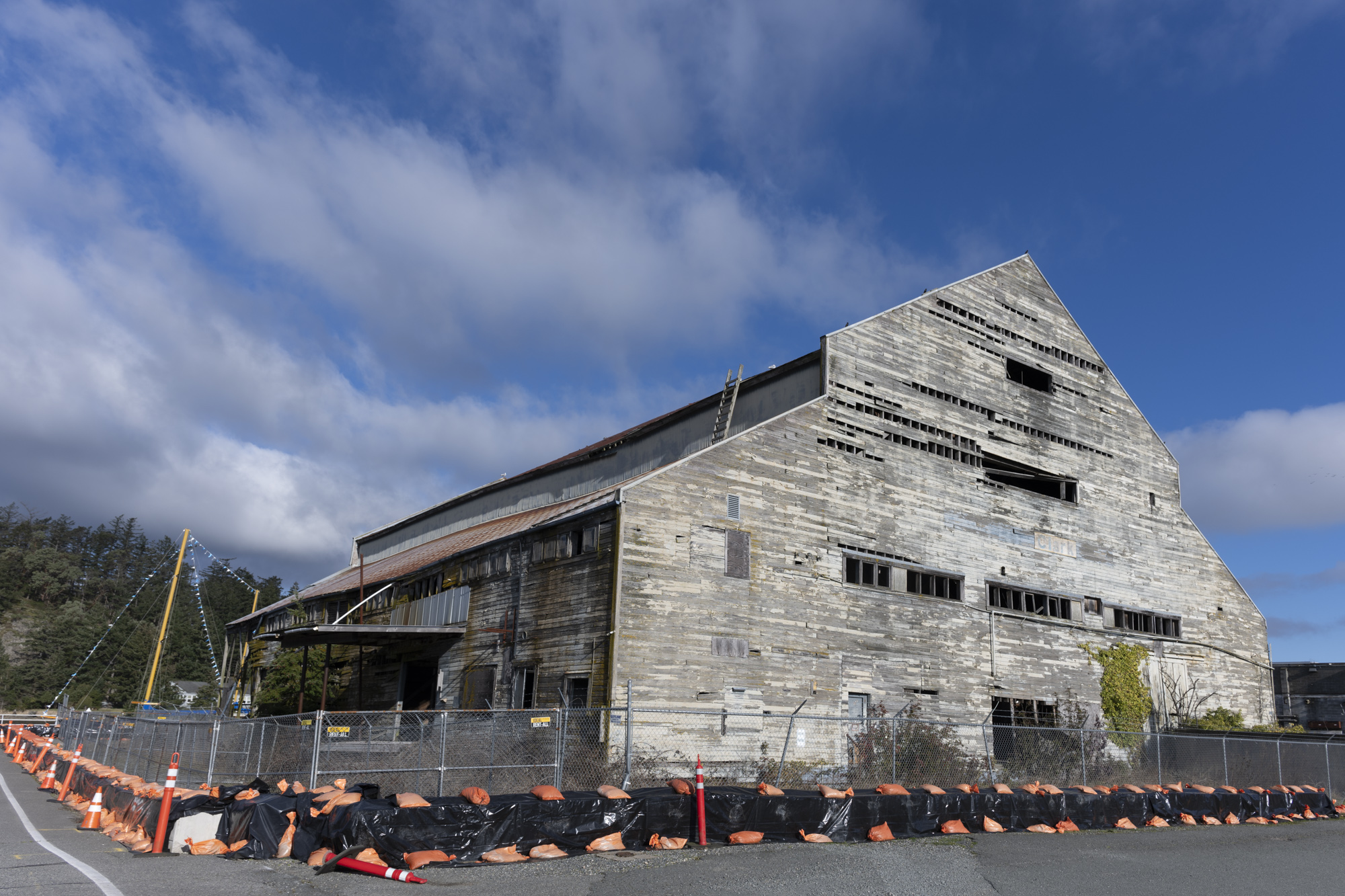
Since then, the towering, nearly 130-year-old former Moore-Clark fish warehouse has fallen into serious disrepair. Its state of dilapidation is such that the Town has deemed it a public safety hazard and installed fencing around its perimeter, blocking pedestrian access on south First Street along the shoreline side of the building.
Shelter Bay residents Lori Wise and MaryLee Killinger, noting potential dangers posed by the aging structure, shared with commissioners a news account of how Seattle has enacted new legislation making it easier for the city to demolish vacant buildings.
“If the City of Seattle can do it, why can’t we get that thing (the old warehouse) torn down?” Killinger asked.
Davolio said the situation isn’t so simple here.
“Part of the building,” he acknowledged,” is on the public right-of-way. But to condemn it is an extremely complicated and costly process.”
“The big issue,” stressed Commission Chair John Leaver, who is a La Conner Community News board member, “is money.”
Assistant Planner Ajah Eills encouraged Wise and Killinger to present their concerns to the Town Council, which will review potential uses for the entire old Moore-Clark property, not just the warehouse, within the week.
WWU students contribute to La Conner’s comprehensive plan update
The advisory board heard presentations from Western Washington University students who reported on draft documents they generated for consideration in the Town’s ongoing comp plan update. One student group took on revisions to La Conner’s Critical Areas Ordinance to comply with the state Growth Management Act. Another group tackled a proposed Right-of-Way ADA (Americans with Disabilities Act) Transition Plan.
“It was a ton of work,” said Assistant Planner Ajah Eills of the student project, which was overseen by Professor Tammi Laninga of the WWU Department of Urban and Environmental Planning & Policy. “It will be helpful to our Public Works Department for projects and in our grant applications”
Eills said material from the student presentation on the Right-of-Way DNA Plan will be inserted into the transportation element of the comp plan. The WWU report on Critical Areas will factor into the comp plan’s climate element.
“We’ve benefitted from our relationship with Western,” Davolio said, “and hope it will be a continuing relationship.”
